

Is There Such A Thing As A 12V Air Conditioner?
Yes, there is such a thing as a 12 volt air conditioner, and they can be powered using 12 volt batteries.
The bigger question is, what’s the best way to power a 12V air conditioner and what kind of situation is it the best for.
Related Product: Power an RV AC using a smaller generator using a Hutch Mountain Microair Easy Start (click to view on Amazon)
Traditionally RVs and camper trailers come with 120V air conditioners that use a lot of electricity.
They require being plugged into full 30 or 50 amp power or need a large generator that can output enough power when boondocking.
But 12 volt air conditioners are a little different. They don’t require as much initial electricity and so long as the batteries they are being powered with can output a high enough amperage they can run quite a while on deep cycle batteries.
12 volt air conditioners are becoming more and more common in smaller campers and vans. They aren’t as common as standard 120V RV air conditioners but there are a few good options out there.
See Also: Best RV AC Units Reviewed (13,500 & 15,000 BTU)
In this review, I’ll go over a few 12V AC units that can be powered using deep cycle batteries and even a swamp cooler that can be powered using the 12 volt outlet in your car.
The main thing to remember is that 12V air conditioners aren’t as powerful as standard 120 volt ones and they are going to perform best in smaller spaces like a van, truck camper, small trailer, or cabin.
Highest Cooling Capacity
Best Overall
Last update on 2024-04-25 / Affiliate links / Images from Amazon Product Advertising API
12 Volt Air Conditioner Reviews
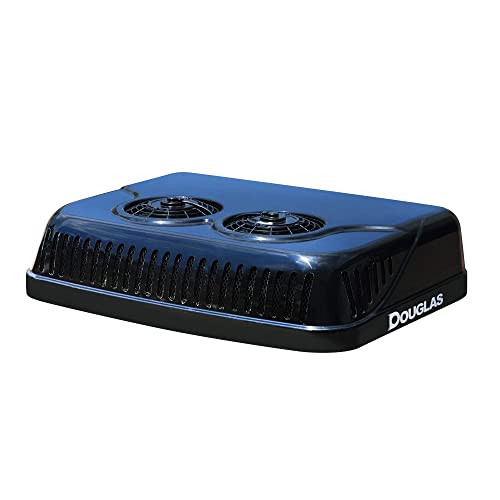
Douglas D20 Rooftop 12V Air Conditioner
The Douglas D20 rooftop 12 volt air conditioner is as close as you can get to a traditional RV AC.
It has the highest cooling capability in this review at 9,800 BTU. A standard 120V RV AC is normally 13,500 to 15,000 BTU.
It is mounted to the roof and can fit in a standard 14×14 inch square hole that is often found in RVs. If you are installing it on the roof of a van or truck you will only need to drill four 2.8 inch holes for the air intake and outlet.
There’s an inner panel that’s mounted to the ceiling inside that covers the air intake and outlet holes and also has the controls you use for setting the temperature.
This is a non-ducted air conditioner which means the air will only come out from the vents on the inner panel. I recommend mounting it in a central location in your van or camper.
The rooftop unit weighs 11o lbs and measures 32.7 inches long, 24.8 inches wide, and 7.6 inches tall.
All the basic installation to the roof is pretty standard and straightforward.
The 12V air conditioner will then be connected directly to a 12 volt battery via the included cables.
The battery powered system makes this air conditioner a lot more simple to wire than a 120 volt one.
The maximum current it’s rated to draw is 48 amps on a 12 volt system. That’s 576 watt-hours.
Since this is going to be used as a battery powered air conditioner when camping I’m going to give a few examples of the run time you can get out of some basic deep cycle batteries.
See Also: Best Deep Cycle RV Batteries (AGM, SLA, 12V, 6V)
If you have an AGM battery that has a 100 ah capacity like this one by Renogy (click to view on Amazon) you will be able to run this 12V AC for around 1 hour at full speed. The number is a little low because you don’t want to run an AGM battery below 50% discharge.
A lithium battery can be discharged as low as 20% before taking damage which means a 12 volt 100 ah lithium battery like this one by Renogy (click to view on Amazon) will be able to run the Douglas AC at full speed for a little over 1 1/2 hours.
You can easily add more 12 volt batteries by wiring them in parallel to get more run time for your 12V air conditioner.
You can also be charging them at the same time using solar panels to help extend the run time.
The Douglas D20 Rooftop 12V Air Conditioner is a fantastic option for boondockers who want to be able to run an air conditioner without having to use a converter to get 120V power.
The Douglas is smaller than regular RV AC units which means it uses less power and it doesn’t have the high starting watts of a regular AC.
If you have a large battery bank this is a fantastic option.
PROS
- High Cooling Capacity
- Easy To Install
- Low Max Amp Draw (48)
CONS
- Heavy
- Roof Mount Only
- Only One Speed Setting
ACDC 12V Air Conditioner
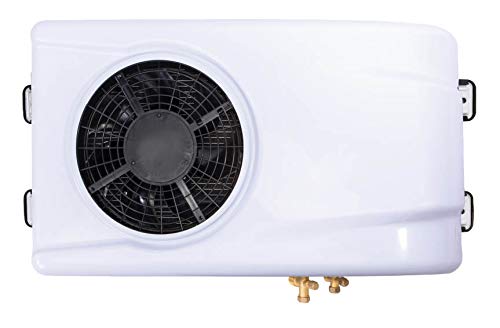
The ACDC 12V air conditioner doesn’t follow the typical van or camper AC style but if you have the space for the inside unit it’s a quieter and more energy efficient option than the standard roof mount versions.
This is a split system air conditioner which means the compressor is in a box that’s mounted somewhere outside and the intake and output fan is inside.
The outdoor compressor unit measures 33.9 inches long, 16.9 inches wide and 8.9 inches tall. It weighs around 5o lbs.
It can cool up to 6,000 BTU. That’s about half the power of a standard RV AC but it’s pretty good for a 12 volt air conditioner and plenty of power for a small camper or van.
The cool thing about this compressor is it can be mounted in any position. This means you can have this mounted on the back of your camper or van and not the roof which stops the wind drag issue you get with roof mount ac units.
It can even be mounted underneath your camper.
The inner AC fan unit is 24.8 inches long, 13 inches wide, and 7.5 inches tall.
It takes up a lot more space than the inner panel of a roof mount RV ac but the benefits are that you can mount it pretty much wherever you want and it’s a lot quieter.
The inside and outside units are connected using 10 foot long rubber hoses. The necessary battery cables and fuses are also included.
See Also: Best Portable Solar Panel Charger For RV Camper/Boondocking
The power is controlled via a remote that can adjust the temperature and setting. This 12 volt air condition can also be a dehumidifier and just a fan that uses less power.
Installation is going to be a little more tricky with this since you need to find somewhere to mount 2 units. And you need to be able to run the vacuum lines.
The good news is you only need to drill a hole to the outside unit that is big enough to fit the cables. You won’t need a large 14×14 inch hole in your roof which is a huge plus.
Now for the energy consumption and how to run this 12V AC with batteries.
Since there are different settings and power levels this AC will use anywhere from 25 to 66 amps or 300 to 795 watt hours.
If you have an AGM battery that has a 100 ah capacity like this one by Renogy (click to view on Amazon) you will be able to run this 12V AC for around 45 minutes at full speed and up to 2 hours at the lowest setting.
A 12 volt 100 ah lithium battery like this one by Renogy (click to view on Amazon) will be able to run the AC at full speed for a little over 1 hour and 3 hours on the lowest setting.
You can easily add more 12 volt batteries by wiring them in parallel to get more run time for your 12V air conditioner.
You can also be charging them at the same time using solar panels to help extend the run time.
The ACDC 12V Air Conditioner is a fantastic option for boondockers with small campers or vans.
You don’t have to mount it on the roof which means you will save your gas mileage, it’s quiet, and has different power settings which means you can adjust the power usage depending on the capacity of your battery bank.
If you have some space on the wall of your small living space I highly recommend this style of battery powered 12 volt air conditioner.
PROS
- Quiet
- Can Be Mounted In Any Position
- Doesn’t Require Large Roof Hole
- Variable Power Usage (Low & High Settings)
CONS
- Large Inner Unit
- Must Run Cables To Connect Both Units
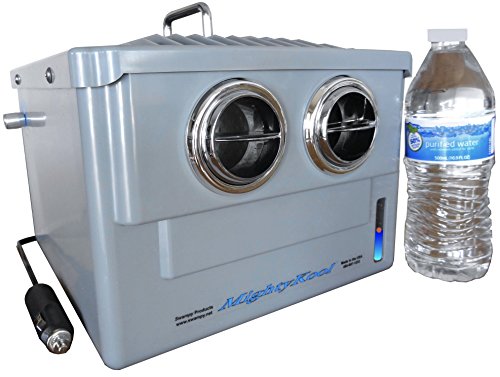
MightyKool K2 12V Air Cooler
The MightyKool K2 12V air cooler is not an air conditioner, and it’s not going to be able to cool an entire RV or van.
But what it can do is give you some cool air in the area you are in to help make life out at the campsite a little more bearable on hot days.
Have you ever seen those posts about how to make a homemade air conditioner? What you do is put ice in an insulated box and have a fan pull the cold air from inside the box and onto you.
This is a little more fancy version of that. It runs on 12V power using a 12V plug and instead of ice, you add water.
It uses the same principle as a swamp cooler. The hot outside air is taken into the cooler and pushed through fins that are being cooled by the added water.
The air that comes out the other side isn’t going to be super cold but it will be cooler than the warm air going in.
See Also: Best Portable Power Station/Solar Generator For Camping
The fan speed can be adjusted and it will draw anywhere from 0.8 to 2.4 amps per hour. That’s 10-29 watts per hour.
If you don’t have a big battery bank in your van or camper this might be a simple way to get some cool air.
A simple AGM 100 ah deep cycle battery would be able to run this fan for 21 hours.
You can also plug it right into your vehicle if you live in a van and run it off of the car battery. Just make sure you don’t run the battery too far down so your car won’t start.
The box measures 12 inches long, 11 inches wide, and 8 inches tall. It weighs around 5 lbs when not full of water.
The MightyKool K2 12V Air Cooler will not keep you cold on super hot days and it’s not going to be able to spread cool air very far.
It’s perfect for having next to you when you’re working at a desk or by your bed at night.
It’s not an air conditioner, but it’s a good 12 volt alternative you might want to consider for boondocking.
PROS
- Affordable
- Low Electricity Usage
- Has 12 Volt Plug
- Different Fan Speeds
CONS
- Not An Air Conditioner
- Only Cools Area Directly In Front Of It

What To Look For In A 12 Volt Air Conditioner
Low Power Usage
Traditional RV air conditioners are huge electricity hogs. Most campers and vans don’t have the means to power them for very long.
12 volt air conditioners use a lot less power and they don’t require the high amperage to start the compressor.
There are a few sizes of 12V AC’s and choosing the right one for you might have a lot to do with how much battery power you have to run them.
Does It Actually Cool?
There are a lot of portable “air conditioners” on the market today. Some companies claim their small 12 volt air conditioners are able to cool spaces as big as vans and campers but a lot of times that isn’t true.
Any real air conditioner that actually puts out cold air is going to use a decent amount of power and is probably not going to be super lightweight and affordable.
Checking to see if it uses a compressor is a good way to see if it’s really an air conditioner or not.
In this review, there are two real 12 volt air conditioners and one that’s just an air cooler.
The AC units use a lot more power and are not nearly as affordable, but when it’s really hot outside the difference between them and the air cooler is going to be huge.
Mounting Style
If you are someone who travels a lot like many van dwellers do you may not want a bulky rooftop air conditioner cutting into your gas mileage.
In this review, there is one rooftop mount 12V AC and one that can be mounted anywhere.
At the same time, the roof is a good out of the way and clean place to put an AC and that style doesn’t take up any space inside your van or camper.
See Also: How To Easily Replace An RV AC With A Fan, Vent, or Skylight
My Choice For Best 12 Volt Air Conditioner
Either of the first two 12 volt air conditioners in this review are going to be great options for smaller campers and vans.
As a boondocker myself I like to be able to change the power usage of the appliances I use. So my pick is the ACDC 12V Air Conditioner (click to view on Amazon).
I like that you can change the fan speeds so easily or choose to just run the fan to save a little power.
It’s also very quiet which is a lot nicer for both daytime and at night.
My main complaint about the RV AC in our motorhome is how loud it is when running.
Even though it’s only a 6,000 BTU AC I think it could be very usable in even medium sized travel trailers and motorhomes.
The 13,500 BTU AC in our motorhome is almost too powerful and it would be nice to have something smaller that doesn’t instantly freeze the inside of your camper.
I like that you can mount it wherever you want that that it’s remote controlled. The only big downside is the space the inner unit takes up.
But if you have a good spot for it I say it’s one of the best options for a DC air conditioner out there.
See Also: Can I Run My RV AC When It’s Raining Or During Thunderstorms?
Frequently Asked Questions About 12VAC Units
Does A Battery Powered AC Really Work?
Yes, they do, but in most cases, you are going to need a pretty big battery.
Real 12 volt air conditioners that can run off of a battery require at least 25 to 70 amps in order to run. You are going to need a battery that can output that for long enough to make having an AC worth it.
How Does A 12 Volt Air Conditioner Work?
Using a more advanced technology a 12 volt air conditioner has a more efficient compressor inside it that doesn’t require high starting watts like a traditional 120 volt ac does.
A 12V AC works mostly the same after that, but they are often rated with a lower BTU output and are often less affordable.
Is There Such A Thing As A Propane Air Conditioner?
While propane can be used to cool some things like refrigerators there is currently no propane air conditioner.
The BTU rating on an RV AC can be confusing and makes it seem like it’s using propane but so far they only run on electricity.
What Kind Of Battery Is Best For A 12 Volt Air Conditioner?
Since even a 12V air conditioner is going to use a lot of power I recommend a deep cycle battery that can be drained without being damaged and has a lot of recharge cycles.
A battery bank using multiple 12 volt LiFePO4 Deep Cycle Lithium Batteries with at least 100 ah is going to be a good place to start.
A deep cycle lithium battery can be discharged down to 20% capacity before taking damage which is a lot better when compared to traditional lead acid batteries including AGM which start being damaged at around 50%.
They also take putting out higher amperage for longer amounts of time better and often have a longer life than regular lead acid batteries.
For that reason, I recommend lithium for all boondockers who want to be able to live off grid using only batteries and solar power.
Have any more questions about 12 volt air conditioners for van, RV, and home use? Leave a comment below.


How many batteries 100 amp do I need to run12v air con
Hi Tim,
It depends on how long you want to run your AC. Most of the 12 volt ones use more than 50 amps every hour. I would get at least two, maybe even 3.