
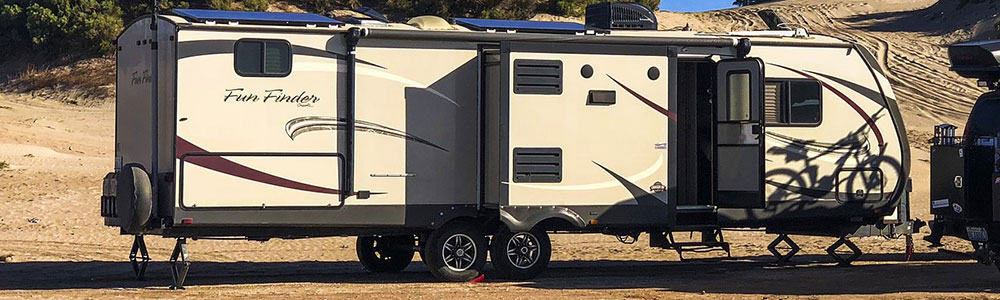
What Are RV Stabilizer Jacks?
There’s sometimes a little confusion about what RV stabilizer jacks are and how they differ from regular jacks or RV leveling jacks.
Camper stabilizer jacks are not meant to lift any part of an RV or trailer. They are just there to support and reduce shaking and sway while the RV is stationary.
Related Product: Add snap on SnapPad Rubber RV Jack Feet (click to view on Amazon) to your RV stabilizers to add grip and eleminate the need for RV blocks.
RV leveling jacks, on the other hand, are meant to lift an RV but they are mostly only found on high end Class A RVs.
I’ve never seen a travel trailer with leveling jacks (except for the tongue jack) and the only kind of leveling jack on a 5th-wheel is the front ones that you use to raise and lower it off the hitch.
Because of this, RV stabilizer jacks don’t necessarily need to have a weight rating because they aren’t meant to hold a lot of weight.
When choosing the right kind of stabilizer jacks for your camper it mostly comes down to what kind of style you want, how tall they need to get to reach the ground, and if you want them to be permanently installed.
See Also: What Is The Best RV Stabilizer System?
In this RV stabilizer jack review, I’ll go over 6 different styles of RV stabilizers that are the best of their kind.
If you’re tired of your RV shaking every time someone moves or the wind blows this is the right place to start fixing it.
Best For Travel Trailer
Best For Motorhome
Best For 5th-Wheel
Last update on 2024-04-15 / Affiliate links / Images from Amazon Product Advertising API
Best RV Stabilizer Jacks Reviewed
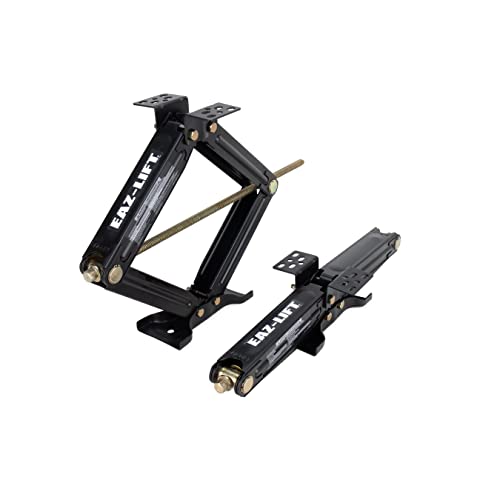
1. Camco RV Stabilizer Scissor Jack
Scissor stabilizer jacks are probably the most common type of stabilizer you will find on a camper.
They are effective, simple to install, and they fold up out of the way when it’s time to move.
The only slight downside to this style of RV stabilizer is the time it takes to put all 4 down if you’re only using a hand crank.
Luckily the process can be sped up with the use of a drill and a 3/4 inch socket.
The Camco Eaz-Lift RV scissor jacks are the best of their kind and most likely an upgrade from what’s already on your camper.
There are a few different heights and weight capacity options. As I mentioned before it’s mostly about the height since the jack isn’t meant to lift any weight anyways.
You want the RV scissor jack to be able to reach the ground when your camper is level with a little bit left over for when the ground is uneven.
See Also: Best Electric Travel Trailer Tongue Jacks Reviewed
The version linked to above is the most heavy duty. Each jack has a weight capacity of 7,500 lbs (that doesn’t mean you should lift with them) and can extend from 4 3/8 inches to 24 inches.
A single jack weighs about 12 lbs.
They are made to be either bolted or welded onto the frame of your RV or trailer. If your RV already has some and you are looking for a replacement the odds are that the holes for the Camco scissor jacks will line up.
You could also use these as a temporary RV stabilizer you just set up whenever and where ever you need it.
Some motorhomes don’t have a spot for you to bolt these on where they will be out of the way when driving. But you can use them, then put them away when you need to move.
Each RV jack is made with heavy duty steel with a powder coat finish that is rust and corrosion resistant.
This specific option comes in a pack of two and there is a power drill socket included for fast set up.
The Camco RV Stabilizer Scissor Jack is one of the best ways to stop motion inside a camper and these are super easy to install.
They are made with high quality materials and there are a few different height options for different sizes of campers.
PROS
- Easy To Install
- Very Effective
- Can Be Perminitally Attached Or Temporary
- Lightweight
- Great For Unlevel Ground
CONS
- Slow Set Up Time Without Drill
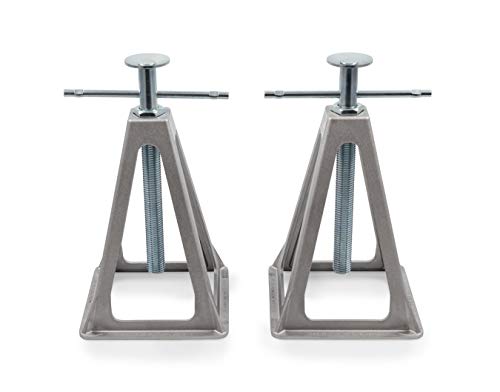
2. Camco Olympian RV Stack Jacks
A second popular style of RV stabilizer is the Camco stack jacks. These look a lot like the jack stands that are normally for automotive use but they are not quite the same thing.
These are only for RV stabilization and not for holding the weight of an RV or car.
Even with that being said they are still rated to support up to 6,000 lbs. So you know they are going to be able to handle some RV movement when set up properly.
The nice thing about this style of RV stabilizer jack is they are lightweight (only 4 lbs) and can be used anywhere the frame can be accessed on a camper.
That means if your RV already has stabilizer jacks but you want just a little bit more support to stop sway or movement you can add these stack jacks.
The design is very simple. It’s a large heavy duty bolt with a flat foot that screws into a strong aluminum stand that’s a triangle shape.
See Also: The One And Only Guide To RV Leveling Blocks
Just put them under your RV where you want them and unscrew the bolt until it touches the RV frame.
One thing to watch out for is the height of these camper stabilizer jacks. Because of the stand, the lowest they can be is 11 inches and the max height they can reach is 17 inches.
Measure the spot you want to place them before purchase to make sure they will fit. If the spot is a little higher than 17 inches you can always set the stack jack on an RV leveling block (click to view on Amazon) or a block of wood.
The Camco Olympian RV Stack Jacks are perfect for motorhomes that just need a little bit of extra support when staying a few weeks in a campground or extra large campers that need some extra stabilizers.
They require no installation and they are very lightweight for storage.
PROS
- Lightweight
- Can Be Placed Almost Anywhere
- No Installation Necessary
- Aluminum
- Very Effective
CONS
- Lowest Height Is 11 Inches
- Slow Set Up
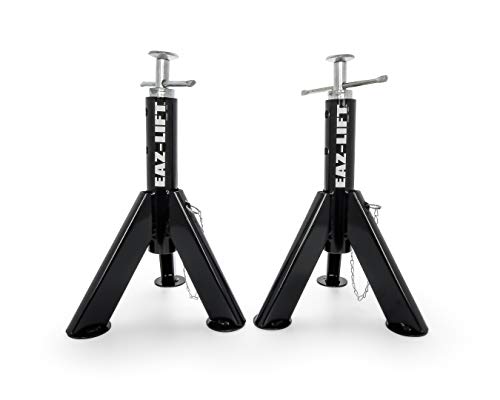
3. EAZ LIFT Telescopic RV Stabilizer Jack
The EAZ LIFT telescopic RV stabilizer jacks by Camco are a much fancier version of the RV stack jacks reviewed above.
The concept is the same but the execution is much different.
First off these camper stabilizers are made of steel with a rust resistant powder coating. They are fairly heavy weighing around 11 lbs and they have a weight capacity of about 6,000 lbs.
Note these are still just stabilizer jacks and they are not meant to take the full weight of any kind of RV or vehicle. They are just meant to stop movement, not hold weight.
There are two moving parts to these RV stabilizers. First, there’s a steel tube that sits inside a tripod stand. The inner steel tube can be moved up or down using a pin.
See Also: How To Set Up At An RV Park Or Campground For Dummies
The second part is a steel bolt you use to fine tune the height of the EAZ LIFT to make it the exact length you need it to be to stabilize your camper.
The telescopic part that uses a pin makes the set up much quicker since you can pull up the inner tube so it’s almost the height you need it at before having to use the bolt.
They can adjust from 16 inches tall to 30 inches and are removable. There is no hardware installation required to use them.
The EAZ LIFT Telescopic RV Stabilizer Jack is for campers who like the idea of a removable RV stabilizer jack but they want something that can be set up a little faster than the Camco Stack Jacks reviewed above.
PROS
- Can Be Placed Almost Anywhere
- No Installation Necessary
- Very Effective
- Fast Set Up
CONS
- Lowest Height Is 16 Inches
- Heavy
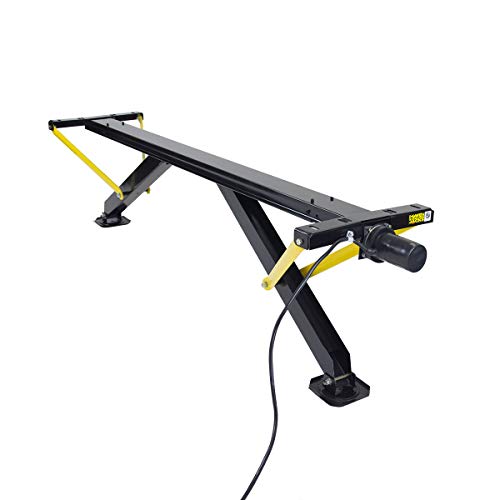
4. Lippert Components Power RV Stabilizer Jacks
The fanciest way you can go with RV stabilizer jacks is to get some that are electric.
The benefit to these is no more having to kneel down and mess with 4 different RV jacks. All you have to do is press a button to extend or retract them.
Lippert Components high speed power RV stabilizer jacks can be found on a lot of 5th-wheels and some travel trailers.
They work by using two jacks that are connected to a motor via a large bolt that runs down the middle.
When you press the button the RV battery powers the motor which turns the bolt and lowers both jack feet at the same time.
The feet can extend as far as 30 inches and when they fold up the entire thing including the motor is only 4 3/4 inches tall.
This kit comes with one set of jacks and a switch to power them.
Installation is a little more difficult with this style of RV stabilizer and you are going to need to wire the jacks to your RV batteries as well as install a switch somewhere accessible.
If you aren’t comfortable doing this yourself an RV dealer or RV repair shop can most likely install them for you.
The motor and switch are waterproof and the supports and jacks are all made of steel. Everything is powder coated to be rust resistant.
See Also: Best Deep Cycle RV Batteries (AGM, SLA, 12V, 6V)
If you want to add these to your camper make sure there’s a spot that’s long and wide enough to fit the entire support bar. It needs to be able to be bolted to the frame without any tanks or other RV parts getting in the way.
The entire unit is 78 inches long, 20 inches wide, and 4 3/4 inches tall. It’s also 58 lbs so make sure you have a little help if you plan on installing it at home.
We used to have power RV stabilizers just like these on both ends of our travel trailer. They worked well and the only upkeep required was a little grease on the main bolt every now and again.
One tip is when lowering them if you need one foot to be at a different height than the other you can actually grab one of the feet when halfway extended and slide it up or down. The foot on the other side will move the opposite since they are connected in the center.
Also, make sure you have the right manual crank with you at all times. You may run out of power or the motor could malfunction and you want to always have a way to bring the power jacks back up manually.
The Lippert Components Power RV Stabilizer Jacks are awesome for campers who travel a lot and want something that makes setting up at the campsite a little less work.
The initial installation is a little more advanced but once they are on they’re going to be a lot less work than manual RV stabilizer jacks.
PROS
- Electric
- Fast Set Up
- No More Cranking
CONS
- Difficult Installation
- Not Compatible With All RVs
- Heavy
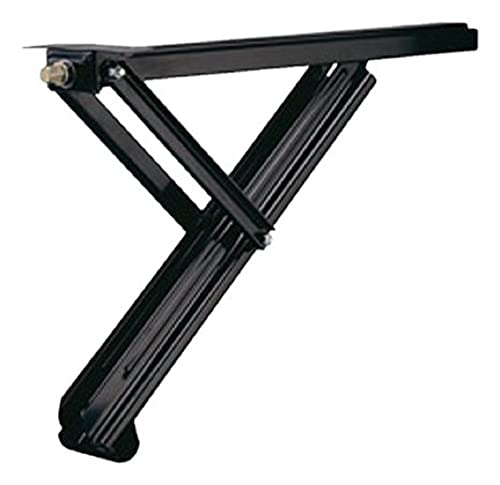
5. BAL Stabilizer C-Jacks
These C-Jacks by BAL are similar to the power RV stabilizer jacks reviewed above but you have to use a crank or a drill to raise or lower them. Each unit is also just one jack and not two connected across a long bar.
This design of camper stabilizer is super effective because they create a strong triangle shape on every corner of your RV which helps stop even more side to side motion.
To install all you need to do is bolt the top bar to the frame of your RV.
These jacks are made of steel with a rust resistant powder coating.
See Also: 6 Best Collapsible & Telescoping Ladders For RV Use
They weigh around 14 lbs each, since they are true stabilizer jacks they have no weight capacity rating but they are strong enough for most sizes of travel trailers and campers.
The leg can extend as far as 25inches.
The BAL Stabilizer C-Jacks are a more simple style of RV stabilizer but they are very effective and are fairly easy to install.
If you’re worried about the work required to crank down each leg you and always use a drill and a 3/4 inch socket to speed things up.
PROS
- Farily Easy Set Up
- Compatible With Most RVs
- Lightweight
- Create Sturdy Triangle Shape
CONS
- Slow Set Up Time Without Drill
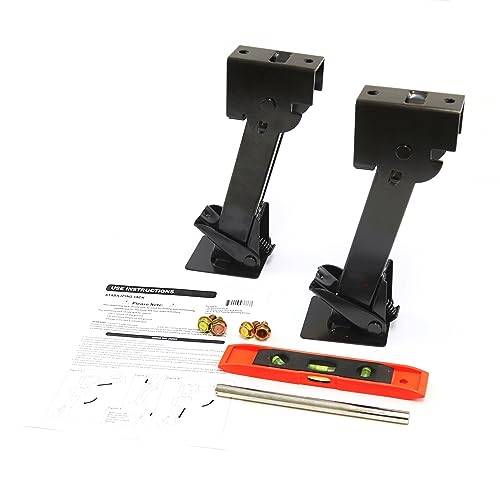
6. Red Hound Folding Stabilizer Jacks
This style of RV stabilizer is probably the least heavy duty of all the kinds in this review, but they are still a good permanent and lightweight option for smaller trailers and campers.
The way they work is they are bolted to the frame of the camper in the corners. When you want to use them you fold down the first tube until it clicks into the support position. This makes the jack about 12″ tall.
Then to adjust it to the height you need just release the foot with a spring loaded lever. The feet can extend out another 6 inches making these jacks 18 inches in total.
See Also: Andersen Levelers 3604 With RV Campers – How They Work
These RV stabilizers are nothing fancy but they will get the job done. Each weighs only 5 lbs and they are rated to support up to 1,000 lbs even though they are only supposed to be used to stabilize.
The jacks are made with steel with a rust resistant powder coating.
The Red Hound Folding Stabilizer Jacks are super simple but if you have a pop-up camper, small travel trailer, or even a ramp on a toy hauler you need to be held up they will do the job.
PROS
- Lightweight
- Simple Install
- No Cranking Necessary
CONS
- Minimum Height Is 12 Inches
- Not For Larger Campers
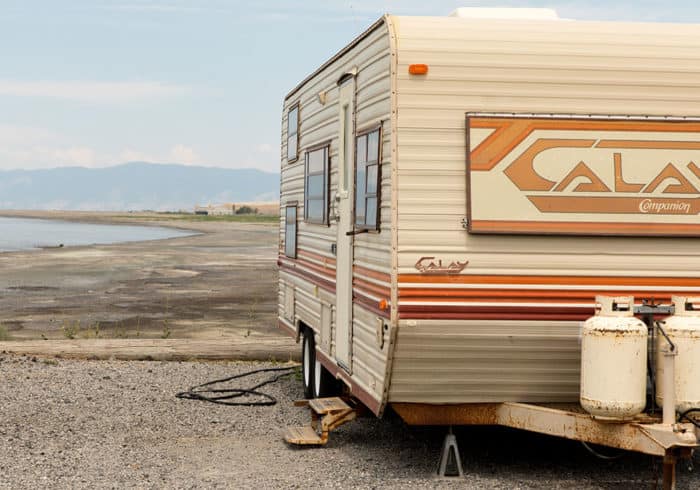
My Choice For Best RV Stabilizer Jacks
There are a surprising number of options when it comes to stabilizer jacks for campers. Each one is a little different and best for different sizes and kinds of RVs.
The best choice ultimately depends on what camper you have and how often you travel.
For 5th-Wheels & Travel Trailers
If you move around a lot a powered option like the Lippert Components Power RV Stabilizer Jacks (click to view on Amazon) is a good way to go since they don’t require as much work as the other styles.
If you stay in RV parks for weeks or months at a time the Camco RV Stabilizer Scissor Jack (click to view on Amazon) may be all you need.
Speaking from experience using both styles of RV stabilizers with different travel trailers I can tell you that the scissor jacks do help stabilize an RV a little bit better than the powered kind.
Powered RV stabilizer jacks are still great at reducing sway but they aren’t as solid as having 4 individual jacks placed in the outer corners of a camper.
That being said the power jacks are plenty for campers who travel a lot and they do save time when setting up in a campsite.
If you don’t mind the set up time my choice is actually the Camco RV Stabilizer Scissor Jack (click to view on Amazon) over the Lippert Components Power RV Stabilizer Jacks (click to view on Amazon).
But both are still great options.
For Motorhomes & Vans
For motorhome and vehicle camper use, I recommend the Camco Olympian RV Stack Jacks (click to view on Amazon) for those who stay put for weeks at a time.
For those who travel daily the EAZ LIFT Telescopic RV Stabilizer Jack (click to view on Amazon) is a heavier but much quicker to set up option.
Many motorhomes and vans don’t require stabilizer jacks and they often don’t have a big enough spot on the bottom for installing permanent ones.
That’s why temporary stack jacks are a better choice for that style of camper.

Frequently Asked Questions About RV Stabilizer Jacks
What size stabilizer jack do I need for my RV?
While some RV stabilizer jacks are more heavy duty than others and have a stronger more weight bearing design, the weight rating isn’t necessarily the most important thing.
RV stabilizer jacks are never meant to raise your camper or hold the weight of it in any way.
There is a different kind of RV jack called RV leveling jacks that are meant for this but they are mostly only found on large motorhomes and the front of 5th-wheels.
Because of this, stabilizer jacks just need to be able to fit where you want them. They also need to be able to extend far enough to get a secure foot on the ground.
If you scroll up you can see my recommendations and top choice for the best size and kind of RV stabilizer jack for different kinds of campers.
Can you lift an RV with the stabilizer jacks?
Even though some RV stabilizer jacks have weight ratings that technically should be able to hold the weight of your camper, you should never lift an RV with the stabilizer jacks.
Stabilizer jacks are made to support an RV, not to lift it. The bulk of the weight of a camper needs to be on the suspension system and the tongue jack on a travel trailer, or the front leveling jacks on a 5th-wheel.
Using RV stabilizer jacks in the wrong way may end up damaging the frame or the suspension of your camper.
What are the different types of RV stabilizer jacks?
In this review, there are 3 basic types of RV stabilizer jacks.
The first is the very popular scissor jack. Scissor jacks are a very simple device that uses a jackscrew and physics to allow a person to manually lift a lot of weight using just a hand crank.
The jack will slowly push down as the screw turns to pull the arms of the scissor jack inward.
This design works really well for RV stabilizer jacks because they are very strong, and can fold up and out of the way for travel. Because of this they are usually permanently installed on the corners of a camper.
The second style of RV stabilizer jack in this review is more of a jack stand that uses a vertical jack screw to adjust the height.
This style is more universal since the area under the camper it needs to be set up can be very small. You just need to be able to get to a couple of inches of the frame and you’re good to go.
While these stabilizers are very strong and can also technically lift an entire camper they are only meant to help support and not take the weight off of the main suspension system.
The third type of RV stabilizer jack in this review is a foot that is lowered down using a horizontal screw. One is technically two feet being lowered by one jackscrew and the other is an individual foot being lowered by one screw.
This type of jack can be very effective. There are normally support bars that extend halfway down the stabilizer leg creating a triangle shape on the frame of the camper.
That means there will be two points of stability connected to the frame on each leg.
Why do you need an RV stabilizer?
RVs sit on a suspension system and tires for travel. They are made to bounce around while being driven or towed to help stop things from shaking apart from road vibrations.
The suspension system works great for keeping everything together but when not in motion the camper will still bounce around from people walking around inside or even outside forces like the wind.
RV stabilizers help support the suspension system and stop it from rocking around. They are not made to lift a camper but to simply put a little bit of force on the corners to stop it from rocking around.
They are also helpful if your camper has a slide out. Slide outs often make the weight of a camper a little uneven on one side and stabilizers can help stop the camper from leaning.
That’s why you should always put the stabilizer jacks down before putting out the slides.
Some small travel trailers, motorhomes, and vans don’t need RV stabilizers because the suspension is stiff enough to stop most of the movement.
Getting some universal stabilizer jacks like the stack jacks in this review can still be a nice addition to help reduce the movement of the leaf springs under the camper.
How to use RV stabilizer jacks?
The best way to use RV stabilizers is to lower (or raise) them until they touch the ground (or frame) and then just add about 1/2 an inch more so some support is being made but most of the weight is still on the campers suspension system.
You may need to add a little more height after a few days because the feet of the RV stabilizers can sometimes dig into the ground if it’s soft.
RV stabilizer jacks don’t take away 100% of the movement of a camper. If your camper is still moving a bit there are other things you can do to reduce the movement but raising the stabilizer jacks more normally isn’t the answer.
You can check out this article here for other ways to stabilize an RV.
How many RV stabilizers does my camper need?
Most travel trailers require 4 RV stabilizer jacks. 5th-wheels normally only need two in the back because the two leveling jacks in the front also double as stabilizers.
Motorhomes can have 4 but usually, it’s only necessary to add two in the back because motorhomes stand on 4 tires and already have 4 points of contact with the ground.
What other ways can I stop my RV from shaking?
As I mentioned a little before RV stabilizer jacks help with RV shaking but they won’t take it away 100%. Luckily there are other products out there that can be used to eliminate even more movement.
You can check out this article here to see even more RV stabilizer options that can be used with RV stabilizer jacks to make your camper feel more solid, like a house.
Have any more questions about RV stabilizer jacks? Leave a comment below.

