

Why Your RV Needs A Wireless Digital Weather Station
There is more to weather than just accurate temperatures, and having a weather station can give you a lot of info about what’s happening both indoors and outdoors, so let’s take a look at the best weather stations for your RV or home.
So what is a digital weather station? While it might sound like something complicated and expensive, it can be as easy as a wall-mounted digital screen indoors with a sensor outdoors.
Related Product: See how level your RV is using an App on your phone with the LevelMatePro Wireless RV Leveling System (click to view on Amazon)
This digital screen can give you all kinds of information in addition to temperature.
Exactly what information depends on each product, but it’s common that you can read the indoor and outdoor humidity, the weather forecast, the barometric pressure, moon phase, high and low records, and also time and date with an atomic clock.
Most of them are wireless and portable so you can move them around your home or camper.
But wait, you might say, I can do all of this online on my phone or computer already. Well, sure you can.
But how accurate is that information? And should you rely on that if you’re out in the woods and need to know if it’s going to be windy to where you should retract your awning?
Will your phone warn you ahead of time and alert you when it’s freezing outside that your pipes are in danger? And do you have service everywhere you go?
I do know you can find a lot of great weather information online, and if none of these questions make you want to get a weather station, maybe you shouldn’t.
But in my opinion, in addition to the safety information, it will give you, it’s also fun to track the temperature, humidity, and air pressure at the places you go to.
See Also: RV Condensation And 14 Ways To Prevent Mold In Your Camper
I get that one product doesn’t fit all, so I am going to share some digital weather stations that have minimal features, and some that are more advanced and feature-rich.
A word you might run into is barometric pressure, and I have answered a question in the FAQ about what it is and how you can be your own weatherman with the information based on it.
Below are the best personal weather stations for RV and home use reviewed followed by my recommendations based on different criteria and finally the FAQ section where you will find answers to common questions surrounding weather stations.



Best Overall
Most Basic
Most Advanced
Last update on 2024-04-25 / Affiliate links / Images from Amazon Product Advertising API
Best Weather Stations Reviews & Info
1. La Crosse Technology Forecast Station

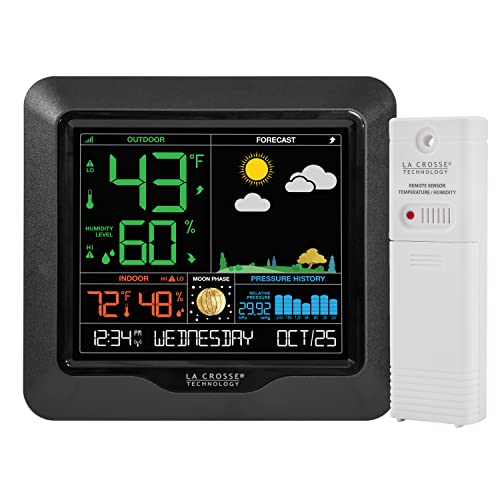
I have the old model of this digital weather station and like it so much that I had to put it on the list.
With accurate temperature and humidity readings for both indoors and outdoors, a surprisingly accurate forecast, an atomic clock, pressure history, and customizable alerts, it might be everything you’re looking for in a weather station for your home or RV.
Mine is wall-mounted and has been running on batteries ever since I bought it a couple of months ago. The screen is dim when on battery power, but still easy to see from different angles.
If you want to use the backlight you can turn it on with the press of a button or connect it to AC wall power.
See Also: How To Find Dump Stations And Fresh Water
It’s very portable since you don’t have to keep it plugged in 24/7. If you’re close to an outlet it’s worth connecting the AC adapter though to save on battery power.
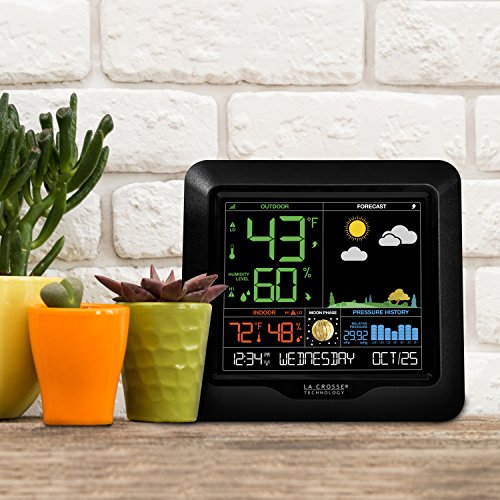
This model has colors, moon phases, and a seasonal foliage background that changes every three months.
The wireless sensor requires two AA batteries and has a working temperature range of -40°F to 140°F (-40 °C to 60 °C).
Buttons on top of the weather station let you set alerts and control other settings. There is also a light button if you want to activate or adjust the digital display brightness.
The La Crosse Technology S84107 Color Forecast Station is a fantastic basic option for an accurate indoor and outdoor thermometer with a few extra features.
It’s small and easy to hang up inside an RV. I use Command Velcro Strips (click to view on Amazon) so I can easily remove it from the wall to change the settings and so far the batteries have lasted more than a year without needing to be changed.
I highly recommend this weather station to full-time RVers and weekend campers.
PROS
- Accurate Temperature Readings (Indoor & Outdoor)
- Measures Humidity (Indoor & Outdoor)
- Moon Phase
- Wireless Outdoor Sensor
- Large LCD Display With Optional Backlight
- Portable
- Can Set Alerts
- Atomic Clock
- Battery Power Option (Long Battery Life)
- Small Enough To Hang With Command Strips
CONS
- Short Battery Life If Backlight Is Left On 24/7
- No Backlight When Battery Powered
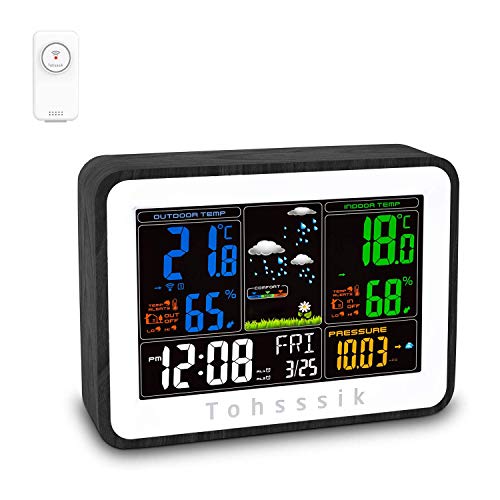
2. Tohsssik Weather Station
Tohsssik makes this digital weather station that is one of my top picks in this review due to its features, simplicity, design, and accuracy.
With an included wireless outdoor sensor, you can monitor and keep track of both indoor and outdoor temperatures and humidity.
You can also read the current barometric pressure on the digital screen or take a look at the forecast, presented to you in colorful icons.
The Tohsssik unit will let you know whether it’s going to be sunny, partially cloudy, rainy, or snow.
One feature I haven’t seen in every other weather station is the 3-level brightness that lets you decide how bright you want the digital screen to be. If it’s on battery power, it will stay dim until you interact with it to preserve battery life.
See Also: RV Depreciation Rates And Why It Matters What Years You Buy An RV
Being able to set the screen to dim or bright will be a useful feature if you place this in a bedroom. Set the screen to dim when you head to bed, and you won’t be bothered by a large bright screen when you’re trying to fall asleep.
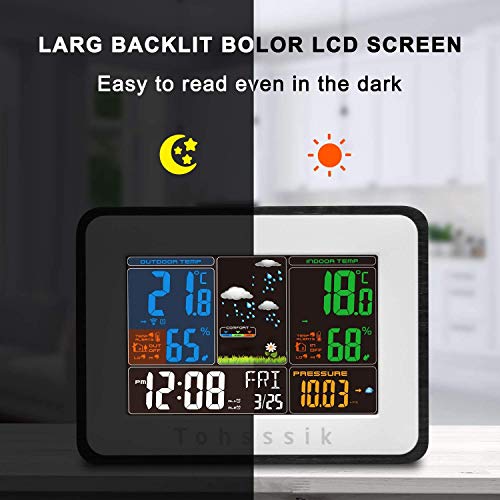
Since it has a snooze clock alarm and temperature alarms, it can be very useful in a bedroom.
The forecast is based on the barometric pressure, and you can connect up to three sensors to one unit, note that only one wireless sensor is included with the purchase. You can buy additional ones here (click to view on Amazon).
Last but not least, one of the best things about the Tohsssik weather station is the fact that the power cord is a USB cable. I wish more manufacturers would realize that we want USB cables and not simple AC plugs.
With the USB power cord, you can connect this to 12V power in your RV or simply connect it to a power station (click to see post on best ones here) in your camper. I like being able to choose between batteries and regular power and the Tohsssik weather station is a fantastic choice for RV or home use.
The only downside for travel purposes is it’s not recommended to hang the screen on a wall which means you will need to put it away before travel or secure it to a table.
PROS
- Clock & Temperature Alarms
- Moon Phase
- LCD Screen
- Adjustable Brightness
- Forecast Predictor
- Accurate Temperature Readings (Indoor & Outdoor)
- Measures Humidity (Indoor & Outdoor)
- Portable
- Can Be Battery Or USB Powered
CONS
- No AC Plug For USB Included
- Cannot Hang On Wall
3. La Crosse Technology Wireless Forecast Station
La Crosse Technology is an American company that wants to bring technology, time, and weather together and have done so with a lot of their products. The one weather station I have decided to take an extra look at today is the model C85845 weather station.
It has an adjustable backlit colored display that will give you some more information than the basic temperature and humidity.
Other than that info for indoors and outdoors, it will give time and date, a forecast, trends, and customizable alerts based on temperatures and humidity.
See Also: Best Portable Quiet Inverter Generators
You can choose to plug it in with the included AC adapter, but also use it with AAA batteries.
Note that the backlight and adjustable settings are only optional when the weather station is plugged into AC power. It can still be battery powered but the backlight will not stay on.
The humidity range it can read is 10% to 99%. The outdoor temperature range is between -40˚F to 140˚F if you use lithium batteries.
La Crosse makes solid personal weather stations with accurate readings.
So what makes it worth it over the very basic ThermoPro TP-60S (click to view on Amazon)?
Well, you either like the colored design or you don’t. It also has a more information filled screen which means it will be using more power. But it gives you a lot more information than just the temperature and humidity, and it looks really nice hanging up on the wall of a camper.
The LCD screen is larger than the other La Crosse weather station reviewed above which makes it much easier to read from a distance.
It also has a wireless range of 300 ft vs. ThermoPro’s 200 ft.
The customized alerts you can set can be worth a lot if you camp in cold weather where you have to worry about pipes freezing.
Overall, theLa Crosse Technology Wireless Forecast Station is a great portable digital weather station with accurate temperatures and forecasts. It’s a solid choice both for your home and your RV if you want to know more than just the basics.
PROS
- Customized Alerts
- 300ft Wireless Sensor Range
- Heat Index & Dew Point Info
- Adjustable Backlight
- Barometric Pressure Reader
- Forecast Predictor
- Accurate Temperature Readings (Indoor & Outdoor)
- Measures Humidity (Indoor & Outdoor)
- Large Colored LCD Screen
- Can Be Battery Or AC Powered
CONS
- Does Not Display Barometric Pressure
- No Backlight When Battery Powered
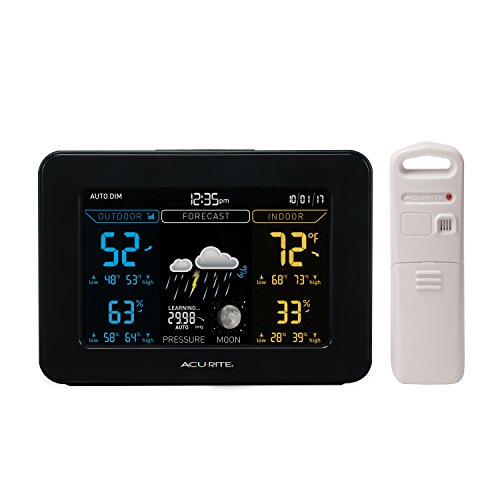
4. AcuRite Weather Station

AcuRite is another popular company that has a lot of weather stations on the market. I am going to review one of their more simple ones and one more advanced. Starting with the model number 0227A1.
It has a color display that includes a picture behind the forecast. The AcuRite 02027A1 will run on AC power and batteries and has an adjustable digital display for saving energy.
Like most of the weather stations in this review when only using battery power the display screen backlight will automatically turn off to save power.
See Also: 10 Unwritten Rules When Staying Overnight At Walmart
For features we have indoor and outdoor temperature and humidity with low and high records, also showing trends pointing up or down.
A barometric pressure reader will show pressure on the screen, together with the moon phase, time and date, and a forecast.
The wireless remote sensor has a range of 330 feet and it has a built-in hole on the top you can use to easily hang it. It’s powered by 2 AA batteries, for best results, AcuRite recommends using lithium ones.
The AcuRite Weather Station has, in my opinion, the best looking screen in today’s review. I like the simple and easy to read dark theme but if you want something a little fancier the is also a white display option (click to view on Amazon) that has a lot more colors on it.
Unfortunately, both versions are missing alerts.
PROS
- Moon Phase
- Barometric Pressure Display
- Forecast
- 330 Feet Wireless Sensor Range
- Adjustable Backlight
- Accurate Temperature Readings (Indoor & Outdoor)
- Measures Humidity (Indoor & Outdoor)
- Can Be Battery Powered
CONS
- No Alert Option
5. AcuRite Wireless Home Weather Station

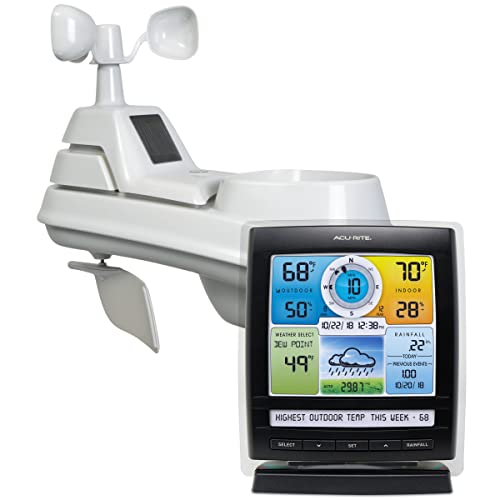
The second AcuRite product today’s review is the model number 01512. This is a more advanced weather station thanks to its big sensor that has more features than just temperature, barometric pressure, and humidity.
The advanced wireless sensor together with the colored display will tell you about rain and rainfall history, wind speed and direction, temperature, humidity, forecast, barometric pressure, and high and low records.
It will also show the dew point which is the temperature at which air is saturated with water vapor. Below the dew point is where water will begin to condense on solid surfaces.
See Also: Best Small Portable Propane Heater For Indoor & RV Use
You could put this on top of your RV roof to get information about windy weather and whether you should retract your awning for example. The sensor can track wind speeds up to 99 MPH and will also show you the direction not only at the moment but the two previous directions as well.
The display likes to be plugged into the wall with its AC adapter but can run off of batteries for backup. The sensor features a 2-year battery life but the batteries are not included with purchase.
What makes this and the next product special in addition to the extra features are the buttons on the front of the display to change what is shown. Some other products have buttons to do this on the back which means you have to take them down if it’s hanging on the wall.
My favorite feature on the AcuRite Wireless Weather Station is the information below the screen where you can scroll through different pieces of information, like the highest temp outside that week, what the “feels like” temperature is, etc.
PROS
- Wireless Sensor With Wind & Rainfall Measurements
- Moon Phase
- Displays Barometric Pressure
- Weather Forecast
- Color LDC Screen
- Buttons On Front (Easier To Use When Wall Mounted)
- Can Be AC Or Battery Powered
- Accurate Temperature Readings (Indoor & Outdoor)
- Measures Humidity (Indoor & Outdoor)
CONS
- Sensor Must Be Mounted On Roof
6. Ambient Weather Smart Weather Station

The most feature-packed weather station in today’s review is from a company called Ambient Weather. It’s a 10-in-1 personal weather station with internet monitoring and it’s even compatible with Amazon’s smart assistant Alexa.
Wind speed and direction, rainfall, outdoor temperature, humidity, solar radiation, UV, barometric pressure, dew point, and wind chill, and heat index are all part of what you can do with this weather station.
As with most others, you should be plugged in with the AC adapter which only consumes 0.5 Watts (1.25 during WiFi configuration mode). It does have the option for backup batteries though and the large wireless sensor is solar powered.

The color LCD display will give you lots of information like indoor/outdoor temperatures and humidity, the barometric pressure, the clock with the date, wind, rain, UV, and solar radiation.
See Also: Best RV Cell Phone Boosters That Actually Boost Signal
You can also get information from the wireless weather station remotely through the internet. Note that it must be connected to the internet to be able to share this info. This can be done with a product like the Verizon Jetpack MiFi if you have cell service.
Not only can you get information about the weather by your sensor online, but also by asking the smart assistant Alexa on supported products questions like “ask Ambient Weather for a weather report.”
Something that can be useful for most people is the smart alerts you can set, which delivers to you in both texts and emails.
The Ambient Weather Smart Weather Station is the first step into a more hardcore weather station suited for homes and RVs.
If you only want temperatures and humidity, this will be overkill. But if the wind and rain are something you’re interested in, you’re going to have a good time with a fully-fledged digital weather station like this.
PROS
- Most Features In Review
- Alexa Support
- Can Access Remotely Through Wifi
- 330 Feet Sensor Range
- LCD Color Display
- Adjustable Backlight
- Smart Alerts
- Wireless Sensor With Wind & Rainfall Measurements
- Moon Phase
- Displays Barometric Pressure
- Weather Forecast
- Accurate Temperature Readings (Indoor & Outdoor)
- Measures Humidity (Indoor & Outdoor)
CONS
- Must Connect Through Wifi (No Bluetooth)
- Must Mount Sensor On Roof
- Monitor Not As Battery Friendly As Others
What To Look For In A Home Or RV Weather Station
Indoor & Outdoor Temperature Readings
Many basic home weather stations will only tell you what the temperature is in the room the monitor is placed in. This is a great type of thermometer for an office or a room you spend a lot of time in but for RV and home use, a weather station that has a wireless remote sensor that can be placed outside is much more useful.
All of the wireless weather stations in the review offer this function but some are better than others. Make sure the signal range will be long enough to reach where you want to place the sensor.
If you have a large home getting one that can connect to multiple sensors can be a great way to monitor what’s going on around temperature sensitive areas.
Humidity
Humidity an important reading for full-time RVers and the basements of homes. Areas with high humidity and warm temperatures can become the perfect place for mold growth and it can happen to anyone.
See Also: RV Condensation And 14 Ways To Prevent Mold In Your RV or Trailer
Many RVers use weather stations just for the humidity feature. If the readings go above 50% you know you need to turn on the fans, crack some windows, or even get a dehumidifier out to help reduce the risk for mold.
Temperature Alarms
Freezing temperatures and RVs don’t mix. It’s easy for the pipes in campers to freeze and often time the area you are camping in gets much colder than what the forecast for the closest town was.
It can be a good idea to set an alarm on a weather station so it will alert you if temperatures reach a dangerous level. You can start taking the steps necessary to stop your pipes from freezing by running water and using heaters.
If you have a specific trouble area in your camper that always gets too cold you can place a remote sensor in that specific area so you can constantly monitor the temperatures. This can be a great way to make sure the underbelly of your RV is staying warm enough if you live in an RV in a cold winter climate.
Wind Sensors
Very few personal weather stations have wind sensors because it requires a large remote sensor that has a small turbine on it to measure the wind speed and direction.
For RVers, the wind can be a problem constantly. It can suddenly start blowing and take out the awning and you want to know the direction it’s coming from when setting up so you can point the RV or trailer nose into the wind.
A wind sensor isn’t a must have but I recommend getting one if you’re a full-time RVer who winters in the windy deserts of Arizona and southern California.
Weather Forecast
Many of the weather stations in this review also offer a daily weather forecast. They predict the weather via barometric pressure readings.
This style of weather forecasting can be correct at times but it’s not nearly as accurate as many would hope.
It can be a good indicator for the next couple of hours but I wouldn’t depend on the weather prediction from any personal weather station unless it’s connected to wifi and able to receive weather forecasts from professional sources.
Conclusion & My Weather Station Recommendations
Personal weather stations offer much more than the standard wall thermometer that only tells you the temperature of the area it’s in.
They can tell you indoor & outdoor temperature, humidity levels, moon phases, barometric pressure, time, weather predictions, and much more depending on how advanced you want to get.
For RV and home use, they are a great way to know exactly what’s going on in your specific area. Often times online weather will tell you the temperatures of your town but you most likely don’t live next to the specific weather company’s weather station and the readings where you are may be different.
You can get weather stations of all kinds. Some are more advanced than others and deciding on the best one for you means deciding on what readings are the most important.
Here are my recommendations based on the different features you can get from a personal weather station.
Best Overall – La Crosse Technology Forecast Station
Even though it won’t give you wind or rain readings the La Crosse Technology Forecast Station is my top pick.
It comes with a small, easy to place wireless sensor that puts out a strong signal.
The temperature and humidity readings are very accurate and I like the placement of the time and calendar.
The monitor is colored to make it easier to see the different kinds of information and it’s small enough to hang on the wall or place on a desk or table.
It is a little harder to see the numbers when the backlight isn’t on but when it’s being powered by batteries it lasts a very long time which is perfect for RV use.
The forecast isn’t always accurate like most weather stations but it’s a fun feature to have and it clearly displays the barometric pressure.
The only thing La Crosse could have done better is to put the control buttons on the front instead of on the top.
Most Basic – Tohsssik Weather Station
The Tohssik Weather Station is small, simple, and easy to use.
The screen isn’t as easy to see as the other larger ones in this review but it’s multicolored and it comes with an alarm clock feature which is a fun bonus.
It comes with a wireless remote sensor to tell you the temperature outside and the humidity. It even has a little weather forecast in the center of the screen.
If you just want something simple to place next to your bed or on your desk this is a fantastic choice.
The only downside to it is they don’t recommend hanging it on the wall which means it has to have a place on a table or desk.
Most Advanced – Ambient Weather Smart Weather Station
If you want to know it all when it comes to the weather the Ambient Weather Smart Weather Station is going to be the best choice for you.
This thing does it all. It has a solar powered wind speed and direction gauge as well as a rainfall measurement tool.
It will also tell you everything else and it’s wifi compatible to boot. You can see the weather at your home or RV wherever you are so long as you and the weather station have internet access.
The monitor is large and easy to read, it also has control buttons on the front which is really nice if you are planning on hanging it up on a wall
Frequently Asked Questions About Weather Stations
Why do I need a weather station for my RV?
To be able to forecast how the weather is going to be when you travel around in an RV is useful, in my opinion.
It’s great to know whether you should pack your gear in because significant pressure changes are hinting that a storm is approaching, or if the wind has changed its direction and a storm nearby might be heading your way.
It’s not just for fun, but for the safety of you and the people around you. Being prepared is always important.
A weather station will give you temperature and humidity levels indoors which will help you regulate to prevent mold and bacteria growth as well.
See Also: How We Fixed A Leaky Slide-Out In Our Travel Trailer
Is it enough to have a weather station to predict the weather?
No weather station is 100% accurate. When you first buy a weather station, you should try to get to learn it. See what it tells you and what is the reality outside.
I also recommend getting an NOAA Weather Radio for emergencies and alerts.
You should also bookmark the weather.gov website where you can click on the map to see a current forecast of where you are located.
Your weather station might malfunction and show incorrect information so having several sources will make you safer.
If you’re a traveler, it’s a good idea to use any kind of tool to monitor temperatures and weather. Being able to monitor temperatures and humidity in your RV might help prevent mold and water damage from freezing temperatures.
How accurate is a forecast on a weather station?
I believe the weather stations that have a forecast feature base it on the change in barometric pressure. You can read below what the barometric pressure is.
Some have forecasts based on past weather and the results of pressure changes. Like with any estimates, they’re not 100% accurate but will give you a general idea about what you should prepare for.

Can I run a weather station on batteries?
Most of the ones reviewed today come with an AC adapter that is recommended to power the receiver unit and its display.
Most of them have space for batteries to have a backup for if you want to move the weather station without losing the data it has collected.
This can be a problem in an RV where you don’t have power everywhere you go unless you have solar panels. You can get a station that turns off the display while on batteries and has to be interacted with to brighten up and then plug it in on occasion to change the batteries, or you can look into solar panels or an inverter.
See Also: Best Portable Power Stations That Include Solar Panels
Whether the weather station you’re considering will be able to run on battery power for months or not also depend on what features it has.
I have the basic La Crosse weather station pictured above, and I haven’t had to change my battery months after buying it.
In the picture, I have turned on the backlit screen, but I can still see and read the dim screen even from far away.
What is barometric pressure?
Barometric pressure, often called atmospheric pressure is what it sounds like, the pressure in the atmosphere.
When the air pressure rises, the air sinks and increases the pressure on the earth, and clears the sky as the barometric pressure is high.
When it falls, the air is rising away from the surface of the earth and now we have low pressure which often means clouds and rain. The lower the pressure, the worse the weather.
If your weather station shows barometric pressure, you might see a number that says 29 something. 29.92 inches Hg is the standard atmosphere pressure where inches Hg is the measurement of pressure.
If your weather station shows a number over 29.92 it means that the pressure is high, and if it goes below 29.92 it means that the pressure is low.
With this information, you can be your own weatherman and predict depending on the pressure how sunny or cloudy the skies will be.

Have any more questions about weather stations for RV and home use? Leave a comment below.


Most RV’s are clad in aluminum. Dies that limit the wireless signal from the sensors from getting to the console?
Hello Herbert,
No, I haven’t had any issues with the sensor not being able to sync to the base station. I have tried both cheap and expensive models. Most weather stations can do at least up to 100 feet even with several walls between.
Hi Folks… I wonder about the wind cups while the RV is going down the road. I don’t see that mentioned anywhere and curious if this is easily damaged due to the speed + the wind it is subjected to. I realize the actual wind speed isn’t going to be accurate while driving, and that isn’t any concern. But what about how well it’s made to withstand being subjected to that wind while driving? Thanks in advance for your advice.
Hello Jerry and Kathy,
Thank you for your comment, that’s an important thing we forgot to mention.
Large sensors with moving parts should be taken down during travel. They’re not made to withstand highway or freeway winds in any way and should only be up and used when the RV is parked.
Jesse
One of the best articles that I’ve read in a very long time! I Took notes and surely gonna implement and test bunch of stuff you talked about.
You’re a beast! Cheers, Ash
Any thoughts on where you would recommend placing the outdoor sensor so that it’s always in the shade on a motor home? Also, how does the Atomic Clock work when moving from place to place? We are rovers who rarely stay in one spot for more that a few days…maybe a week. Do all of these models have to be reset every time you cross a timeline, or are some set up to “converse” with GPS and update automatically?
Hello Jana, so sorry for the late reply.
We’ve velcroed our sensor to the frame of our travel trailer where it’s hidden from the sun at all times. You still have to set a time zone and daylight savings on/off.
Jesse
So, which is the best bet for Boondocking RVr’s? Yes I have solar and inverter, but its a 3000w inverter and does drain the battery. Is there a way to connect to a 12v USB port and bypass the 5v 110 adapter?
It depends on how many features you want. I have the La Crosse S85814 and it has been running on the same batteries for about a year now. The screen isn’t lit up but you can still read it perfectly fine. I have it mounted on the wall inside my camper, and the sensor is velcroed to the frame of my trailer. Not sure how you would power one off of a USB port.
Jesse