
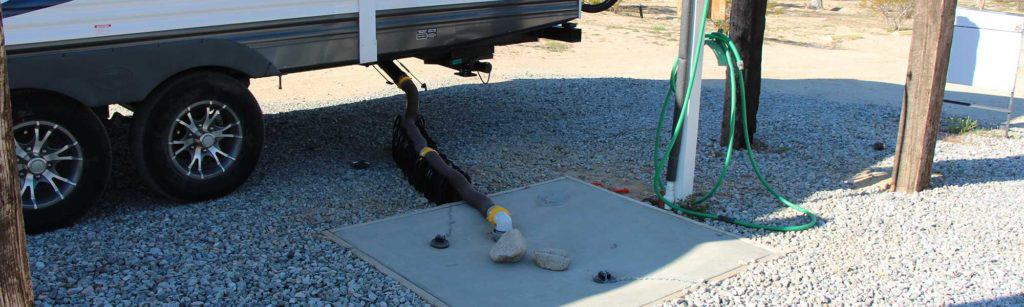
Why Maintain RV Black & Grey Waste Tanks
Dumping your RV, travel trailer, or 5th-wheel isn’t as easy as just pulling up to the dump station, hooking up a sewer hose, and opening a valve.
There are certain things you need to be doing to keep your RV waste and holding tanks from getting clogged and smelly inside your RV.
Related Product: Empty your RV without moving it with the Camco Rhino Portable RV Waste Tank (click to view on Amazon)
If you’ve ever experienced a clogged black or grey tank, you know just how big of a deal it can be.
Just the thought of having to deal with raw sewage should be enough to scare someone into maintaining their holding tanks properly.
The good news is none of this is difficult, it’s mostly about using the right holding tank treatment, adding water, flushing out your tanks, and not leaving your black tank full for too long.
Related: What To Do When An RV Black Tank Or Grey Tank Won’t Drain
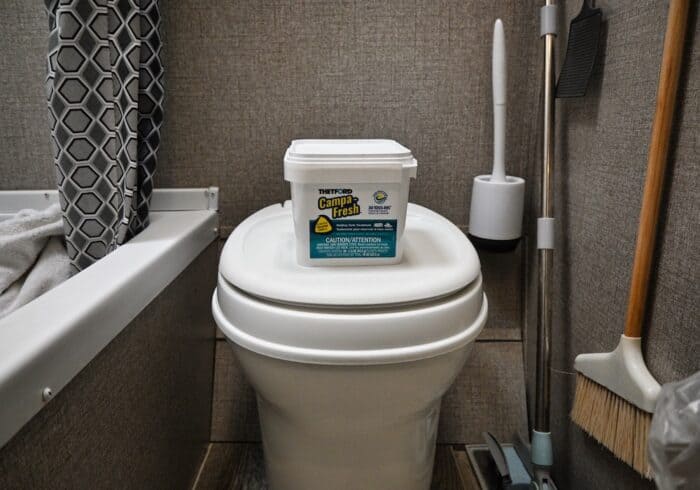
How To Use RV Holding Tank Treatment
RV holding tank treatment is a chemical mixture you put in your RV black tank to help break down toilet paper and other organic sewer matter.
It will help stop clogs and keep your tanks from smelling.
After dumping your RV black and grey tanks take the recommended amount of RV holding tank treatment and put it in your black and grey tank along with a few gallons of water.
This will help clean and break down anything that was left in your RV waste/holding tanks so it will come out the next time you dump your RV.
What RV Holding Tank Treatment Should I Buy?
There are lots of RV holding tank treatments on the market today. It even comes in different forms, liquid, powder, and pods.
But not every treatment is made equally. In my experience, some are better than others.
Getting an RV holding tank treatment that actually works is important because even specialty RV toilet paper can get clogged or collect on the sides of the black tank and mess with the sensors.
See Also: What Do I Need To Use Hookups At An RV Park Or Campground?
I’ll take you through some of the best options out there as well as the RV holding tank treatment I use personally as a boondocker living in an RV full time.
Happy Campers Organic Holding Tank Treatment
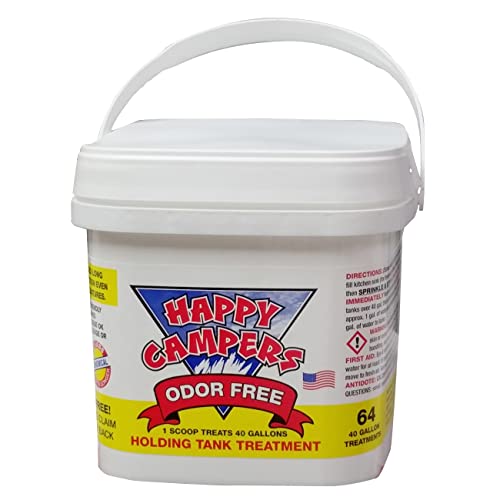
The Happy Campers Organic Holding Tank Treatment is one of the most effective chemicals to liquefy solid waste and toilet paper.
If you use this stuff the right way, you can even get away with using regular septic safe toilet paper instead of expensive RV toilet paper.
A lot of folks use this treatment when de-winterizing and winterizing their RVs and trailers because it’s so good a cleaning waste and holding tanks.
See Also: Best RV Sewer Hose Kits Reviewed & Rated
It’s odor-free, formaldehyde-free, biodegradable (septic system safe), environmentally friendly, and can be used in your grey tank.
It comes in powder form and all it takes is one scoop per 40 gallons of black or grey tank waste. Most black tanks are around 45 gallons, so that’s only one scoop between RV dump trips.
I recommend Happy Campers Organic Holding Tank Treatment for those who boondock often and go longer than 10 days at a time between RV dumps.
It’s also great for getting your holding tanks super clean and a good thing to use at least 2 times a year.
PROS
- Most Effective Treatment Available
- Doesn’t Take Much
- USA Made
CONS
- Not Budget Friendly
Camco TST Max RV Toilet Treatment

This is the liquid version of RV toilet treatment and another popular choice among RVers.
The Camco TST Max Liquid RV Toilet Treatment is guaranteed to stop odors for up to 7 days and comes ins 5 different scents.
It’s not as powerful as the Happy Campers Treatment, but it’s a fantastic basic option and a good choice for those who camp in RV parks and campgrounds with full hookups and dump their RVs or trailers weekly.
See Also: Best RV Portable Waste Tanks For Black & Grey Water
It’s septic-safe, 100% biodegradable, and non-staining.
If you use this treatment and don’t dump your RV very often, consider using toilet paper that breaks down easily and using twice the recommended amount of chemical.
The awesome thing about the liquid form of RV holding tank treatment is how easy it is to dump down sink drains to use in the grey tank.
PROS
- Super Budget Friendly
- Available in Stores
- Orange Scent Option
CONS
- Medium Effectiveness
- Liquid Harder to Store
- Hard to Measure
- Bottle Sometimes Leaks
Walex Porta-Pak Holding Tank Deoderizer Pods

Now for the RV holding tank treatment in pod form. This is by far the easiest form of chemical to use and the least messy. Just pull out a pod, place it in the RV toilet, and flush.
Walex Porta-Paks are filled with powerful powder RV holding tank treatment that is formaldehyde-free, biodegradable, offers excellent odor prevention for both the black and the grey tank.
It breaks down solid septic waste and toilet paper very well.
There are different scents available and even a “bio-pak” option with natural ingredients.
See Also: Best RV Water Hose For Drinking Water
Before getting our hands on the Happy Camper brand, we would use these RV holding tank treatment pods.
When boondocking, we may go even as long as 14 days between dumping the black and grey tanks and we need powerful RV holding tank treatments to prevent clogs and make the dumping process quick and easy.
After dumping our RV I add 3 gallons of water to the black tank and drop in a pod. Then I use another after about 12 days to help break down the waste even more before dumping after 14 days.
When we were using them, the Walex Porta-Pak Holding Tank Deoderizer Pods worked great for us.
The only downside to them was that you had to open a pod to get it to go down the sink to add treatment to the grey tank. It wasn’t much of an issue though. I highly recommend this form of RV toilet treatment.
PROS
- Does Job Well
- Easy to Use
- Pod Breaks Down Quickly
- Budget Friendly
CONS
- Pods Can Stick Together
- Hard to Dump Into Grey Tank
- Must Use Full Packets Every Time
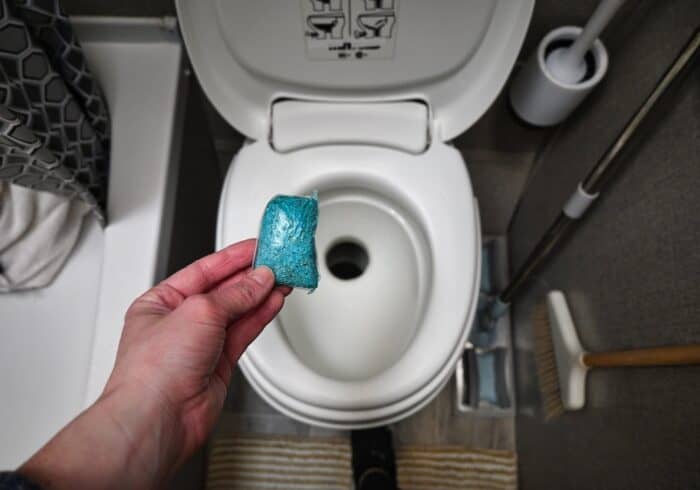
Properly Flushing Out The RV Black Tank
While RV holding tank treatment is awesome and does its job very well, you still need to make sure you properly clean out the RV waste tanks, especially the black tank.
Besides the risk for clogs, one of the most common side effects of not properly cleaning a black tank is the sensors will not get rinsed off and not show the correct levels of your black tank.
Many new RVs, travel trailers, and 5th-wheels have what’s called a black tank flush incorporated into their RV septic system.
If your RV has one, all you have to do is connect a hose to a port usually near the sewer openings gate valves. Let the water rinse out the black tank for a while.
See Also: Best Portable Solar Panel Charger For RV Camper/Boondocking
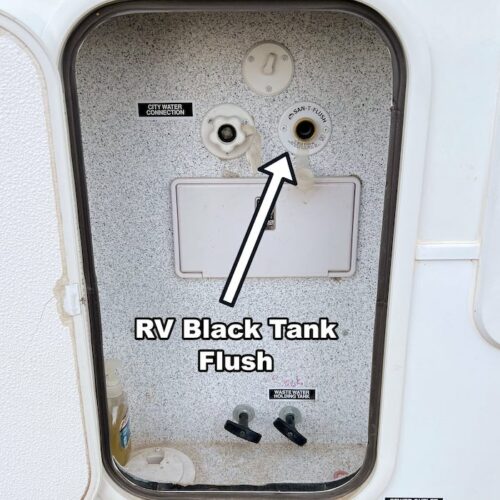
Unfortunately, black tank flushes are not an industry-standard yet and you won’t find one on every RV or travel trailer, especially on more affordable ones.
Luckily, there are products you can use to flush out your black tank that are more effective and easier than sticking a hose down the RV toilet.
Products You Can Use To Flush Out RV Black Tanks
Camco Dual Flush Pro Holding Tank Rinser with Gate Valve

An RV holding tank flusher that connects right to the sewer opening is the easiest way to flush out holding tanks and even break apart clogs.
The Camco Dual Flush Pro Holding Tank Rinser with a gate valve is one of the most effective kinds of RV tank flushers because you can close the gate valve and stop water from rinsing down into the sewer.
That means you can use this to fill up your black and even grey tanks with water to flush them out better.
The version without the gate valve work ok, but I recommend the gate valve version.
It’s also one of the few ways you can flush out the grey tank.
See Also: Best RV Water Filter Systems & Cartridges Reviewed
The only downside to this style of holding tank flush system is sometimes you need to be spraying water from the back of the black tank to force out anything getting stuck in the corners.
If you use this in combination with the Camco Swivel Stik I’ve linked to below, you can do a number on your RV waste tank.
PROS
- Can Flush Out Grey Tank
- Gate Valve to Fill Tank
- Easy to Use
- Small Part is Easy to Store
- No Need to Bring Hose Inside RV
CONS
- Can’t Reach Far Tank Corners
- Best if Used with Stick Sprayer
Camco RV Flexible Swivel Stik
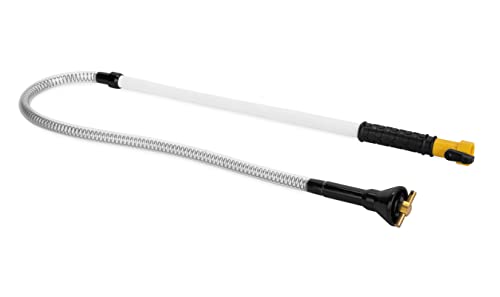
Using a swivel stick like this one takes a little more work than an RV black tank flush or holding tank rinser.
You attach it to a hose that is long enough to go inside your RV (usually through a window) and into the toilet.
It’s not my favorite thing to do, but it’s very effective and a necessary step to properly cleaning a black tank.
All you have to do is start the water, then let the sprayer on the end of the stick do the work and flush out anything that got stuck in the tank.
The flexible end is a nice feature because lots of RV toilets connect to the black tank with a sewer pipe that sits at a 45-degree angle.
You won’t be able to use a straight rinse stick on these kinds of RV toilets and the flexible kind also gets into the tank better.
PROS
- Very Thorough
- Works on Angled Toilet Pipes
CONS
- Requires Hose Inside RV
- Hard to Store
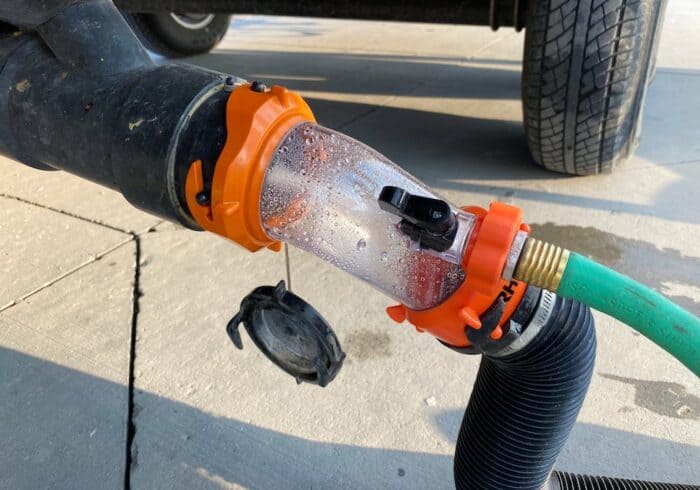
The Final RV Tank Flush
Even after using RV holding tank treatment and properly flushing out the RV waste tanks, you may still have trouble keeping the sensors from getting covered and displaying the wrong levels.
Our sensors said that our black and grey tanks were full for months before we figured out this trick to get them clean.
Once you’ve dumped and flushed out your black tank and closed all the valves. The final step is to take a 5-gallon bucket, add about 1/2 a cup dish soap, and 1 cup of Calgon Water Softner (click to view on Amazon).
Fill the bucket with water and dump the entire thing down the RV toilet. Then add your RV toilet treatment.
RV Life Hack: Equalize RV Batteries That Can’t Hold A Charge
If you are winterizing your RV, drive around the block a few times with this mixture in your black tank to let it work and get your black tank clean, then dump it one last time.
If you are driving to the next campsite, the mixture will have plenty of time to really slosh around. The black tank sensors should be good and clean by the time you get to where you are going.
You don’t have to do this every time you dump your RV, but if the sensors are giving you trouble, it helps.
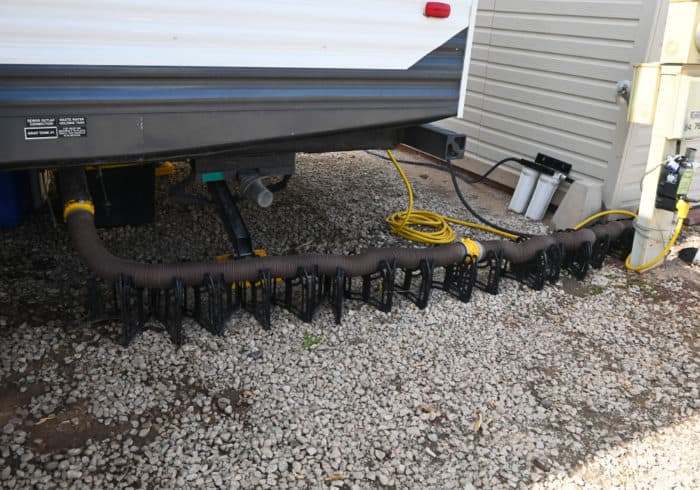
Tips On Keeping Your RV Waste/Holding Tanks From Clogging
If you are dealing with a clogged RV black or grey tank or want to know the best ways to unclog them, check out this detailed article here.
1. Dump Your RV At Least Every Two Weeks
If you dump your RV or trailer often, there will be less time for solid waste to build up inside. This will reduce the risk of clogs.
I’m not saying you need to dump your RV every day but at least once every two weeks will help.
2. Never Leave The Gate Valves Open
I was always told when winterizing an RV to leave the black and grey tank valves open to give them plenty of air all winter.
While this idea sounds good in theory, it often leads to difficult to remove clogs made from solid waste drying and hardening in the black tank over the winter months.
This is another reason you want to clean the black tank out really well when de-winterizing your RV.
On another note, leaving the tanks open may lead to some unwanted pests in the tanks.
Grey tank odors can attract animals. You don’t want to have a family of mice move in over the winter.
3. Dump A Newly Purchased Used RV Before Camping
One of the main downsides to purchasing a used RV or travel trailer, as we found out personally when we bought ours, is many people don’t take care of their campers. You often end up with a lot of things to fix.
We’ve had to replace almost every appliance in our travel trailer, including the water heater, the toilet, water pump, and even the fridge cooling unit.
A very common area that is often overlooked is the black tank.
I’ve read and heard tons of stories about people taking their newly purchased RV camping and using the toilet.
After a nice weekend out, they went to the dump station and discovered the previous owner had not properly cleaned out the holding tanks. Leaving them with a mess to clean up.
You can avoid this by filling up the black and grey tanks with water, dish soap, and RV holding tank treatment and letting it sit for a few days.
Before you go camping, dump your RV and do everything you can to clean it out well. You might be surprised by how much the previous owners left in the holding tanks.
4. Use Lots Of Water
It’s never good to have more solid than liquid in a black tank. You should always start by adding at least 3-5 gallons of water and chemical to the black tank before you use it.
If you are packing up to head to the RV dump station and there’s still some room in your black tank, fill it up the rest of the way with water.
Having more water in the raw sewage mixture will help break up solid waste and toilet paper, making it easier for everything to drain out.
RV Life Hack: How To Check How Much Propane You Have Left
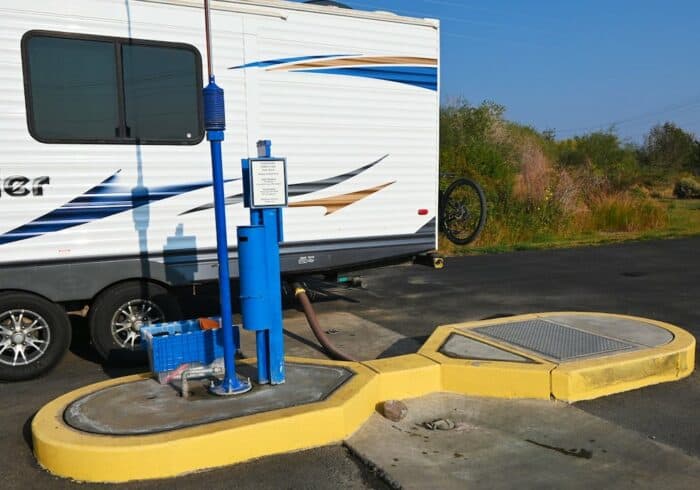
Frequently Asked Questions About Dumping RV Holding Tanks
How often do you need to dump RV waste?
At least every two weeks.
Sometimes people use their RVs as extra living space for guests. Normally, a few guests will not fill up a black tank in the few days they visit.
People can make the mistake of thinking it’s not important to dump their RV because they won’t be using it for a while and the tank wasn’t filled.
The issue with this is the longer waste sits in a black tank, the more likely it is to start to dry and stick together. This could create a clog that may take hours to break apart.
It’s better to dump your RV regularly if you are going to be using the holding tanks and save yourself a huge headache in the long run.
Where can I dump waste from my RV?
RV dump stations are all over the United States.
Lots of towns have public RV dump stations you can use for free or for a small fee you can use the dump station in campgrounds and even RV parks.
For more detailed information on how to find RV dumps and freshwater, check out this article here.
Can you dump your RV grey tank on the ground?
99% of the time there will be signs all over the place, even in empty BLM land, that say no dumping RV grey water.
Some states even prohibit it. Many areas even have regulations on waste water dumping on your own land.
I say it’s better safe than sorry and you should try to always dump your RV grey tank in a sewer.
Also, never dump grey water anywhere near lakes, ponds, swamps, or rivers. The chemicals in your grey water can leak into the water and contaminate it.
See Also: Dump RV Through A Garden Hose At Home! RV Macerator Pump Use
Can you leave the RV grey tank valve open?
While you should never leave your RV’s black tank open, you can leave your grey tank open when winterizing your RV. So long as you have the main cap on so nothing can get into the grey tank (mice).
I don’t recommend it, but some people like to “air out” their grey tank over the winter.
There are air vents that run from the roof of the camper to each RV holding tank. Even if you don’t leave the gate valves open, the black and grey tanks will get plenty of air.
When RV camping with hookups in a nice campground or RV park, some people are tempted to leave their grey tank open all the time.
This is technically ok to do, but you will soon smell the entire RV park sewer in your camper.
The smell travels from the sewer, through your grey tank, and up from the drains in your camper. The odors are not nice and make it not worth it to leave your grey tank open.
See Also: Are RV Electric Waste/Dump Valves Worth It? + Reviews & Info
Why does my RV toilet stink?
If you don’t want those nasty smells coming out of your RV black and even grey tank, you should always use the recommended amount of RV holding tank treatment.
This stops smells from leaking from your holding tanks and makes the dumping process much easier.
If the seal on the part of the RV toilet that moves when you flush isn’t in good condition, it will let the small amount of water that’s supposed to be in the toilet bowl at all times leak into the black tank.
That small amount of water creates a seal to stop odors from drifting from the black tank into the RV.
If you are camping, go open the lid to your RV toilet right now. If you don’t see water, that seal needs to be replaced.
It’s not a very difficult job. Just make sure you order the right part to fit the brand and style of RV toilet.
See Also: RV Toilet Not Holding Water? Try This Simple Fix
Normally, there are only a few bolts holding the bowls to the toilet pedestal. Once the bolts are removed, you can twist it and it should pop off easily.
When the bowl lifts up, you will see the rubber seal sitting on the pedestal. You can replace it will the new one and put the bowl back on.
The new seal should keep standing water in the toilet bowl, which will stop the RV toilet from stinking.
What breaks down toilet paper in an RV?
Septic safe and RV toilet papers are already designed to break down easily in water.
If you want to read more about the best toilet paper for RV septic systems and how to test it check out this article here.
The RV holding tank treatments also have chemicals that help break down toilet paper, even more, to prevent clogs and toilet paper build up.
Can I use household cleaners in my RV holding tanks?
It’s not recommended to use household cleaners in RV tanks.
They may contain harsh chemicals that can damage the tank or plumbing. They’re also not designed to break down waste effectively.
Are there any eco-friendly options for maintaining RV holding tanks?
Yes, there are natural RV tank treatments that use natural enzyme formulas to break down waste and deodorize.
Some of these options include the Walex Bio-Pak (click to view on Amazon) and Clean Camper Holding Tank Pods (click to view on Amazon)
Can I use septic tank treatments in my RV holding tanks?
Home septic systems don’t work the same as RV one, so using septic tank treatments in campers isn’t recommended.
Septic systems usually have a little more time to break everything down. RVs need to clean up fast to stay liquid and ready to dump.
What are some signs that my RV holding tanks need to be cleaned?
The sensors are one of the biggest indicators of a dirty holding tank.
If you’ve just dumped your RV and the sensors aren’t saying empty, there’s probably some unwanted matter stuck to the sides of the tank.
Odors, slow draining tanks, and large chunks are another indicator that the tanks aren’t being cleaned enough each time they’re dumped.
How do I winterize my RV holding tanks?
Giving the tanks a thorough cleaning is the best way to get them ready for winter storage. You can do this by following the steps in this article.
To summarize, they need to be empty and totally cleaned out. If you are worried about them cracking from getting too dry in the cold air, you can always dump in some good quality antifreeze.
See Also: Best RV Antifreeze For Winterizing Your Camper Reviews
Have any more questions about how to properly dump and clean RV holding tanks and prevent clogs? Leave a comment below.

