

Put your RV away in October, come back in April, and the battery is dead. Nothing was left on, nobody did anything wrong, and it happens every year anyway. The battery lost charge two ways all winter: its own slow self-discharge, and the little always-on loads that never sleep.
The Short Version
- Lead-acid batteries self-discharge around 5% a month; lithium closer to 2 to 3%
- The bigger thief is parasitic draw: the propane detector and the other circuits that keep sipping with everything switched off
- A 10 to 12 watt maintainer roughly breaks even with a 50mA leak in winter; 20 watts wins every month
- Above about 5 watts you want a charge controller, and every kit here comes with one
The short answer: about 20 watts of solar with a charge controller keeps a stored RV’s 12-volt battery topped up all winter, while 10 to 12 watts only breaks even. Our pick is the Voltset 20W solar maintainer, a 20-watt kit that’s sealed to IP67 (the standard rating for dust and water; 67 means it survives a short dunk) and rated down to -40°F. Here’s the math behind that number, and the cheaper fixes that sometimes beat a panel.
The usual note: we’re not electricians, and anything you wire to your own battery is at your own risk.
Our picks
The quick answer before the details.
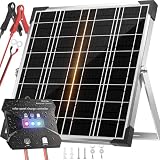
- Our pickVoltset 20W Solar Battery MaintainerView on Amazon

- Most weatherproofIOTBIG 20W Solar Battery Maintainer (IP68)View on Amazon

- Rated for snowSOLPERK 20W Solar Battery Maintainer KitView on Amazon

Full details and the side-by-side table are further down.
Compare all 4 side by side
| Maintainer | Panel | Weatherproof | Rated down to | Mounting | Warranty |
|---|---|---|---|---|---|
| Voltset 20WOur pick | 20 W | IP67 | -40°F | 360° bracket | Not listed |
| IOTBIG 20WMost weatherproof | 20 W | IP68 | -20°F | 360° bracket | 3 years |
| SOLPERK 20WRated for snow | 20 W | IP67 | Not listed | 360° bracket | 1 year after-sales service |
| SUNER POWER 12W Pro | 12 W | IP67 | Not listed | Suction cups | 1 year |
All four come with an MPPT charge controller and list LiFePO4 support. Numbers from the makers’ listings, checked October 2026.
Picked by Jesse · How we pick
- We haven’t run these four on our own rig. We picked them because they’re among the most popular solar maintainers on Amazon.
- Then we held each one up against the sizing math in this article and the makers’ own listings: panel size, controller, weatherproofing, cold rating and warranty.
About Jesse · checked October 2026
Where The Charge Actually Goes
Two separate leaks drain a stored battery: self-discharge, which is the battery’s own chemistry, and parasitic draw, which is everything in the rig that stays on. The second one is usually the bigger leak, and it’s the one a panel has to beat.
Self-discharge is the battery’s own chemistry idling away. Battery University puts lead-acid at roughly 5% of capacity per month. Lithium does better: Battle Born puts its LiFePO4 batteries (lithium iron phosphate, the lithium type sold for RVs) at 2 to 3% a month on average.
Parasitic draw is everything else. The propane detector never sleeps while the power is on (it’s a safety device, and in some rigs it’s wired so the disconnect switch doesn’t touch it; on ours the switch turns it off, and the quick check is whether its light stays on with the switch off). Add stereo memory, the water heater circuit board, and friends. The exact figure depends on the rig, so take a round number: a modest 50mA around the clock is 1.2 amp-hours (Ah, the unit batteries are sized in) a day, about 36Ah a month. A 100Ah lead-acid battery, which only wants to be drained to half anyway, is flat in about six weeks from that alone.
That’s why “nobody left anything on” batteries die: something was on. It always is.
How Many Watts Does It Take?
For a typical rig with a 50mA leak, 20 watts. A 10 or 12 watt panel only breaks even in winter sun, and 20 watts wins every month with room to spare. Here’s where those numbers come from.
Say the rig leaks 50mA continuously and the battery self-discharges 5% a month. On a 100Ah battery that’s roughly 36Ah + 5Ah = about 41Ah a month to replace.
Ten watts into a 12-volt battery, which sits at 13 volts or more while it charges, is about 0.75 amps in full sun. Give it 2 to 3 poor-sun hours a day, and that’s 1.5 to 2.3Ah before losses. Take a third off for dirt, a flat mounting angle and the controller and you’re at 1 to 1.5Ah a day, call it 30 to 45Ah a month. Against a 41Ah leak, a 10-watt panel is break-even on a good month and behind on a gray one, and a 12-watt panel is only a little better. Twenty watts doubles the 10-watt figure to 60 to 90Ah and wins every month. This is why the common advice lands on a 10 to 20 watt maintainer for storage: the small end for a rig with a small leak or sunny storage, 20 watts when the leak is 50mA or the sky is gray.
One rule matters at these sizes: above about 5 watts you want a charge controller (the small box that stops the panel pushing current into a battery that is already full) so a sunny week can’t slowly overcharge a resting battery. The practical answer is to buy a maintainer kit that comes with its controller, and all four below do.
Wherever you mount the panel, run its leads straight to the battery terminals. If it feeds in through the RV’s own wiring instead, a factory solar port for example, check that the port isn’t behind the disconnect switch: turn the switch off for storage and you cut the panel off along with everything else.
Which Solar Maintainer Should You Buy?
For most stored rigs, the Voltset 20W: it has the panel size the math asks for and the lowest cold rating any of the four lists. The other three each win on one thing, a tighter seal, a snow rating or a smaller panel, and every one of them lists an MPPT controller (the efficient kind that gets more out of weak winter sun): built into the panel on the SUNER and a separate box in the other three kits. One catch applies to all four if your battery is lithium: none of them lists a low-temperature cutoff, so read the lithium note further down before you buy one for a LiFePO4 bank.
Our pick
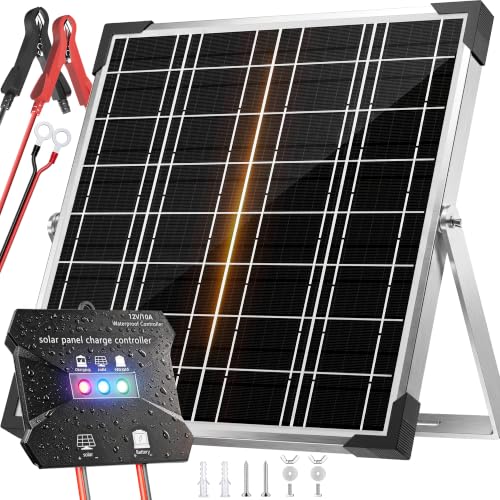
Voltset 20W Solar Battery Maintainer
The 20 watts the math asks for, sealed to IP67 and rated for the coldest storage yards.
20 W Panel
IP67 Waterproof
-40°F Rated down to
Buy it if you
- Store your rig where winters bite
- Want the panel to stay out in weather
- Like a charge-level light at a glance
Skip it if you
- Want the controller built into the panel
- Want a warranty term on the listing
My take
This is the one that lines up best with the math: 20 watts of monocrystalline panel, an MPPT controller that stops charging when the battery is full and starts again when it drops, and LED lights that show the charge from 25 to 100%. Voltset rates it IP67 and from -40°F to 185°F, the widest temperature range any of the four lists (two give none), which matters for a panel that sits on a rig all winter.
It comes with a 360° adjustable bracket, and the controller is a separate waterproof box rated 10 A, with alligator clips and ring terminals for the battery end. The listing page doesn’t state a warranty term, so check it before you order if that matters to you.
Key features
- Panel: 20 W monocrystalline
- Controller: 10 A MPPT, separate waterproof box
- Mount: 360° adjustable bracket
- Connectors: SAE, alligator clips and ring terminals
- Batteries: LiFePO4, AGM, gel, flooded and lithium-ion
- Waterproof: IP67
- Temperature range: -40°F to 185°F
- Status lights: charge level from 25 to 100%
Most weatherproof
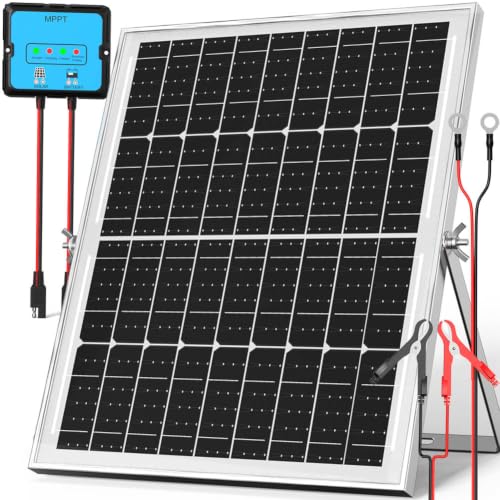
IOTBIG 20W Solar Battery Maintainer (IP68)
The only IP68-sealed kit here, with a tilting bracket, a long cable and a 3-year warranty.
20 W Panel
IP68 Waterproof
3 yr Warranty
Buy it if you
- Want the longest warranty of the four
- Leave the rig outside all winter
- Need cable to reach the roof
Skip it if you
- Store where it drops below -20°F
- Want a kit with a long track record
My take
On paper this is the best-equipped of the four. The panel and controller are both rated IP68, the bracket tilts and turns 360°, the SAE cable (the flat two-pin plug most battery tenders use) runs 10 feet, and the warranty is 3 years, three times what the SUNER and SOLPERK list. It switches to float once the battery is full and has an LED that also warns you about a wrong connection.
The fair warning: it’s new on Amazon, with 27 ratings when we checked against thousands for each of the other three, so there’s little track record behind that warranty yet. And it’s rated only down to -20°F.
Key features
- Panel: 20 W
- Controller: MPPT, with float mode
- Batteries: LiFePO4, gel, SLA, wet and calcium
- Waterproof: IP68, panel and controller
- Temperature range: -20°F to 145°F
- Cable: 10 ft SAE
- Mount: 360° adjustable aluminum bracket
- Warranty: 3 years
Rated for snow
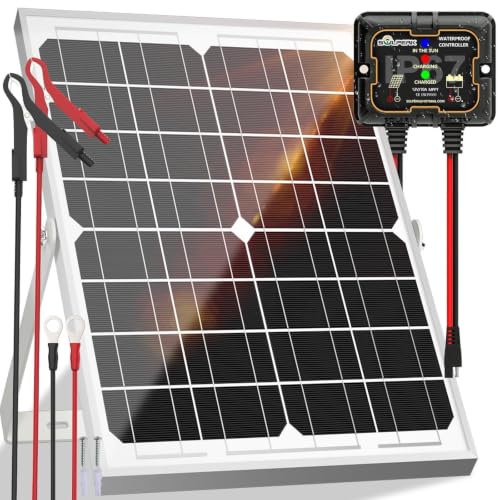
SOLPERK 20W Solar Battery Maintainer Kit
A 20-watt bracket kit sealed to IP67, and the only one here with a snow-load rating.
20 W Panel
5400Pa Snow load
1 yr After-sales service
Buy it if you
- Want to angle the panel at the sun
- Need both clips and ring terminals
- Store under a heavy snow load
Skip it if you
- Need a stated cold rating
- Want the controller built into the panel
My take
Winter sun sits low, and a panel lying flat on a roof loses a good share of it. The SOLPERK’s 360° bracket lets you point the panel where the sun actually is, and so does the IP68 kit’s; what the SOLPERK adds is a snow-load rating, 5400Pa, that no other listing here gives. The kit comes with alligator clips and an O-ring terminal, so you can clip it on for the winter or bolt it to the battery for good.
It’s sealed to IP67, but the listing gives no cold rating, so it’s a safer fit for a rig stored somewhere mild than for a yard that sees -20°F. The controller is a separate box in the kit, and the listing can’t agree on its size (10 A in the description, 8 A in the spec table), which hardly matters for a 20-watt panel that makes about 1.5 amps at most.
Key features
- Panel: 20 W monocrystalline
- Controller: MPPT, three-stage charging, separate box
- Waterproof: IP67
- Batteries: LiFePO4, lithium-ion, AGM, SLA, gel, EFB
- Snow load: 5400Pa
- Mount: 360° adjustable bracket
- Connectors: alligator clips and O-ring terminal
- Support: 1 year

SUNER POWER 12W Solar Battery Maintainer Pro
The small one: enough for a rig with a light leak or sunny storage, not much more.
12 W Panel
9.8 ft Cable
1 yr Warranty
Buy it if you
- Have a small leak or sunny storage
- Want suction-cup mounting
- Keep a small battery topped up
Skip it if you
- Have a 50mA leak and gray winters
- Want a bracket you can angle
My take
Twelve watts works out to roughly 36 to 54Ah a month by the math above, against a 41Ah leak, so this one makes sense for a rig whose leak you’ve measured and found small, or for storage that gets real winter sun. It has a built-in MPPT controller with three-stage charging, eight protections including reverse polarity and over-temperature, and it lists LiFePO4 among the batteries it charges.
It mounts with suction cups and pre-drilled holes, not a bracket, so aiming it at a low sun is up to you.
Key features
- Panel: 12 W
- Controller: MPPT, built in, three-stage charging
- Batteries: flooded, gel, AGM, SLA and LiFePO4
- Protections: 8, including reverse polarity and over-temperature
- Waterproof: IP67
- Cable: 9.8 ft (from SUNER’s own site)
- Connectors: alligator clips, cigarette-lighter plug and ring terminals
- Mount: suction cups and pre-drilled holes
- Warranty: 1 year (from SUNER’s own site, not the Amazon listing)
The Cheaper Alternatives, Honestly
A solar maintainer isn’t the only answer, and for some rigs it isn’t the best one. A disconnect switch or a battery pulled into the garage costs little or nothing, and lithium owners may not need a panel at all.
- The disconnect switch kills most parasitic draw for free, but note what it doesn’t do: in some rigs the propane detector stays live by design, lead-acid still self-discharges, and you lose stereo presets and clocks.
- Pulling the battery into a garage on a maintainer is the classic move, and it also protects lead-acid from hard freezes. A discharged lead-acid battery can freeze and crack at around 5°F, while a fully charged one is good to about -67°F.
Lithium changes the math, and skips the panel. At 2 to 3% a month, a healthy LiFePO4 bank can sit a whole winter and come back fine. Battle Born’s storage advice is the opposite of a maintainer: charge it full, disconnect it (it “does not require a trickle charge”), and keep it above freezing if you can.
There’s a second reason not to point a panel at it: lithium must not be charged below freezing, and none of the four maintainers above lists a low-temperature cutoff. A good lithium battery guards itself (Battle Born’s won’t accept a charge below 24°F), but if yours doesn’t say it does, a panel feeding a cold bank in a storage yard is a risk, not a help. If that’s you, our guide to making a 12V lithium battery last longer covers storage charge levels too.
If your battery keeps dying even outside storage season, the leak hunt in why does my RV battery keep dying walks through finding the draw. For bigger panels that do more than maintain, our portable solar panel roundup and solar charging time math pick up where this leaves off.
What’s keeping your battery alive over winter: the disconnect, a pulled battery on a charger, or a panel on the roof? And if you’ve measured your rig’s draw with the switch off, tell us the number down below.


