

What Is A Diesel Heater?
A gasoline or diesel heater is a small combustion chamber that uses diesel as fuel to create a reaction that puts out a large amount of heat.
Diesel heaters can output a lot of heat while still being fairly small, lightweight, and efficient.
Related Product: We use the reliable VMAX 100Ah AGM battery (click to view on Amazon) to power the heater in our RV.
They are considered to be very safe when installed properly.
That’s why they are becoming popular in camping applications like vans and truck campers.
Diesel heaters are also very fuel efficient when compared to propane heaters and the fans don’t use nearly as much power as a traditional RV heater.
Very low power usage is part of what makes these small heaters so popular for boondockers who use solar power.
For that reason, I think diesel heaters for campers are going to be installed in more kinds of RVs like small travel trailers, motorhomes, and truck campers.
See Also: Portable Vevor Diesel Heater (All-In-One) Review & Setup
Originally, diesel heaters were made by two German-based companies, Webasto and Eberspächer (which is the owner of the Canadian-based company Espar).
Webasto and Espar still make some of the highest quality diesel heaters for campers today.
But there are now other companies making similar diesel heaters that are getting some traction in the diesel heating world.
In this post, I’ll review some of the best diesel heaters by Webasto, Espar, and some of the newer companies as well.
Hopefully, the information will help you decide on what kind is best for your camper or van.
Proper installation is a big part of the safety of these amazing little heaters.
Make sure you get a professional to do it if you aren’t familiar with installing things like gas lines and exhaust systems yourself.
See Also: Best Small Portable Propane Heater For Indoor & RV Use
Summary (links to Amazon)
- Best Overall: Eberspacher Espar Airtronic S2 Diesel Heater
- Best Budget: Vevor 5KW Diesel Heater
- Most Portable: Vevor All-In-One Diesel Heater


Best Overall
Best Budget
Most Portable
Last update on 2024-05-07 / Affiliate links / Images from Amazon Product Advertising API
Best Diesel Heaters For Campers Reviews
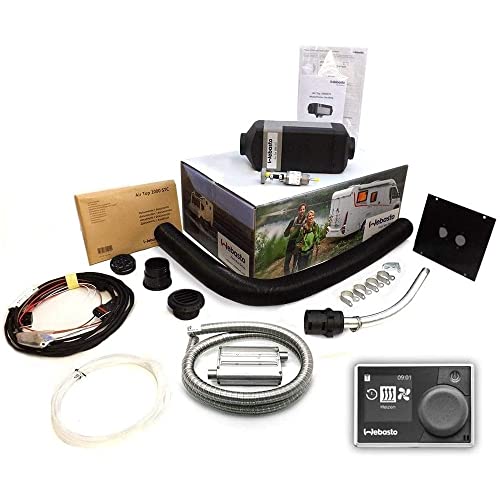
1. Webasto Air Top 2000 STC Diesel Heater
The Webasto diesel heaters are probably the most well known in the camping world and for good reason.
The quality of both the parts and the assembly makes this one of the best options on the market today.
One thing that sets this apart from pretty much every other diesel heater is the waterproof parts.
The Webasto Air Top 2000 STC was originally designed for marine applications,.
They’re fantastic for boats, but they also work very well in vans and RVs.
Since humidity is a big issue in campers getting a diesel heater that won’t rust because of moisture in the air can be a good idea, especially if you mostly live and camp in humid climates.
The smaller 2KW (3,000-7,000 BTU) version linked to above, measures only 21.5 inches long, 14.9 inches wide, and 8.4 inches tall. It weighs around 5.7 lbs.
This is a pretty small option and there are bigger versions by Webasto available.
Even though it’s fairly small, this diesel heater can put out some serious heat and should be enough for vans and small campers.
One of the best features of a Webasto is a fast startup.
Many other diesel heaters will take around a minute for the glowplugs to warm.
The Webasto is faster and will only use around 120 watts of power for a few seconds to fire up.
After startup, you can adjust the fan and temperature speeds. At the lowest setting, it will use around 14 watts, and 29 watts at the highest.
With a good quality deep cycle RV battery you can run this 12 volt heater for a long time.
This installation kit, made and sold by Butler Technik, a licenced Webasto dealer, comes with a dashboard control panel you can install anywhere you can run wires to.
The MuliContol is a simple panel with an on/off button, dial, and LCD screen.
It’s easy to use and understand. Just use the dial to choose and select what you want.
The control panel can change heating levels, fan speeds, and more.
One special thing you get with the premium MultiControl is the ability to set timers up to 7 days in advance.
I also recommend getting the remote room temperature sensor (click to view on Amazon) to pair with the LCD control.
See Also: Best Heated Water Hoses For RV Campers, Barns & Livestock
Another benefit to this high end diesel heater is the noise levels.
Webasto works hard to make its diesel heaters quieter than others.
If you have trouble sleeping through heater noise, this may be the better option for you.
Included with the heater is all the electrical and exhaust parts you will need to install it inside a van or camper.
It also comes with a fuel pump and a fuel line, but there’s no fuel tank standpipe.
If you plan on using your vehicle’s fuel tank, you’ll need to get a compatible standpipe like this one (click to view on Amazon).
This is a high altitude diesel heater that works best at altitudes up to 7,220 feet.
But if you have a gas vehicle but still want to use a diesel heater, you will need to get a separate fuel tank.
If you want quality assurance and a watertight product, the Webasto Air Top 2000 STC Diesel Heater is a fantastic option for all kinds of living spaces.
You can use it in a boat, van, camper, tiny home, cabin, vehicle. Pretty much anywhere it can be safely and properly installed.
Diesel heaters are known for being fuel efficient, quiet, and having low electrical consumption.
Webasto makes some of the best on the market today.
PROS
- Efficient
- Low Electrical Consumption
- Fast Startup
- Quiet
- Watertight Parts
- High Quality Parts & Build
- Small But Powerful
- High Altitude Version
- Advanced Control Panel Included
CONS
- Very High End
- No Fuel Tank Included
- No Standpipe Included
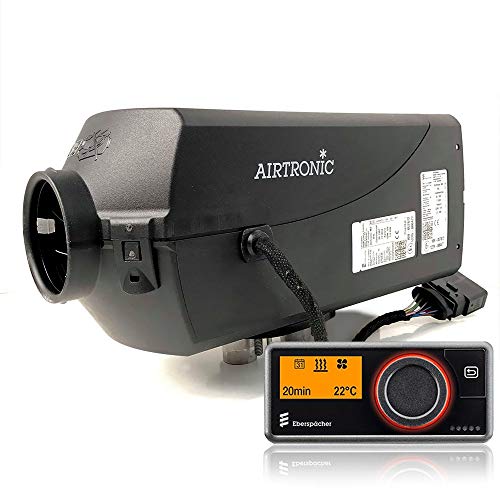
2. Eberspacher Espar Airtronic S2 Diesel Heater
Espar is the second high end diesel heater manufacturer. The Airtronic S2 is one of its best diesel heaters for campers.
This is another small 2.2kW (2,900-7,500 BTU) diesel heater that puts out some serious heat for its size.
It measures 21.5 inches long, 14.9 inches wide, and 8.4 inches tall. It weighs around 17 lbs.
The Espar diesel heater has a fast start, much like the Webasto reviewed above.
The included control system is an LCD screen with a knob.
The controller can adjust heat levels, fan speed, temperature monitoring/settings and program a 7 day timer.
One of the coolest features of the Airtronic is the built-in automatic altitude adjuster that will keep this diesel heater running up to 10,000 feet.
Most other diesel heaters require a separate part to do this, but with the Espar, it’s already set up and will work automatically.
The 12 volt power usage is also fairly low.
The initial glow plug start up will use around 120 watts for a few seconds and then use around 6 to 31 watts depending on the fan speed.
See Also: Mr. Heater Little Buddy Reviewed & Tested For Camping
The fuel pump and motor are made to run extra quiet.
You shouldn’t get that annoying ticking noise that is often found with more budget friendly diesel air heaters.
There’s a lot more included with the Espar as well. You get pretty much everything you need, including a small fuel line.
The only thing you won’t get is an external fuel tank or a standpipe, but you can purchase one separately here (click to view on Amazon).
The Eberspacher Espar Airtronic S2 Diesel Heater is another perfect option for van dwellers or full time RVers who live in small motorhomes or trailers.
It’s definitely one of the more high end options, but you get quality assurance and an incredibly well-built diesel heater with a very useful automatic altitude adjuster.
PROS
- Efficient
- Low Electrical Consumption
- Fast Startup
- Quiet
- High Quality Parts & Build
- Small But Powerful
- Built In Altitude Adjuster For Up To 10,000 Feet
CONS
- Very High End
- No Fuel Tank Included
- No Standpipe Included
3. Vevor 5KW Diesel Heater
Now for the more budget friendly diesel heater options.
Newer companies like Vevor are making some fantastic diesel heaters for vans and campers that are starting to get popular.
Vevor makes a few different sizes of diesel heaters but the 5 kW or 17,000 BTU version is a good overall size for vans and campers.
Made with an aluminum alloy case the heater itself is 15.35 inches long, 4.5 inches wide, and 5.7 inches tall. It weighs around 10 lbs.
The energy usage is around 140 watts when warming up.
It’s going to take around a minute before it starts, so be prepared for a little more power usage right in the beginning.
When running the fan will use anywhere from 6 to 40 watts depending on the speed settings.
The controller is an remote LCD screen with buttons and there’s also a remote fob included that can start, stop, and adjust the temperature.
The screen part takes care of things like starting, diagnostics, and more.
It has an automatic temperature setting that will turn the heater on when the temperature drops below a set point.
You can mount the control screen anywhere you can run wires from the heater.
See Also: Best Portable Electric Heated Blankets For Camping
There is an overheating protection feature that will turn off the diesel heater if it gets too hot.
The included parts to this diesel heater are really what sets it apart from the higher end versions.
It comes with everything you need to install it into a van or RV and there’s even a 2.6 gallon fuel tank included.
You can also connect it directly to a diesel vehicle’s fuel tank.
If you have a gas vehicle or are installing this in a home or camper trailer, you can use the exterior fuel tank instead.
There are manual adjustments you can make for running this 12V heater at higher altitudes but it’s not automatic.
One thing to note about the more affordable diesel heaters is they are often a little noisier and the fuel pump makes a clicking noise.
The Vevor 5KW Diesel Heater is a great budget friendly option that comes with a lot of great extras.
Related: Portable Vevor Diesel Heater (All-In-One) Review & Setup
PROS
- Affordable
- Comes With Fuel Tank
- Remote Control
- All Installation Parts Included
- High BTU Output
- Can Adjust Altitude Manually
CONS
- Parts Not Watertight
- Not As Many Quality Checks As Higher End Versions
- Can Be Noisy
4. Happybuy Diesel Heater
The Happybuy diesel heater is very similar to the one reviewed above.
It has an aluminum body that measures 14.1 inches long, 5.5 inches wide, and 5.5 inches tall. It weighs around 15 lbs.
Happybuy also has smaller and bigger versions available to fit different heating needs.
This version outputs up to 5 kW of heat or around 17,000 BTU.
When starting it uses up to 72 watts and it will take around a minute for the glow plugs to heat up.
When running it will use anywhere from 9-30 watts of power per hour.
The controller is an LCD screen with buttons. It controls things like the startup, fan speed, and temperature.
See Also: 6 Best Camping Wool Blanket Reviews For Tent, RV & Van
The heater noise levels are actually pretty low but the fuel pump does make a pretty loud clicking noise.
There is no altitude adjustment included.
What you do get with this little diesel heater is everything you need for installation and a 2.6 gallon plastic fuel tank.
If you don’t have a diesel vehicle or you want to run this in a trailer or cabin an option that come with a fuel tank is going to be easier to install.
The Happybuy Diesel Heater is a very basic option for a diesel heater.
It a great option if you’re looking for a decent Chinese diesel heater that won’t break the bank.
The controller could be a little nicer but it’s a solid option for heating campers and vans and could be the best choice for your specific setup.
PROS
- Affordable
- Comes With Fuel Tank
- All Installation Parts Included
- High BTU Output
CONS
- No Altitude Adjustments
- Parts Not Watertight
- Not As Many Quality Checks As Higher End Versions
5. maXpeedingrods All-In-One Diesel Heater (Upgraded Version)
Now that we’ve talked about the diesel heaters with exterior fuel tanks, I’m going to mention a few all-in-one versions that come with the fuel tank built into the heater.
This kind of diesel heater is a lot more portable and doesn’t require nearly as much installation as the other kinds reviewed above.
The maXpeedingrods all-in-one diesel heater uses a tall rectangle shaped chassis to fit both the heater and fuel tank into a single unit.
It measures 17 inches long, 6.7 inches wide, and 17.3 inches tall. It weighs around 23 lbs when the fuel tank is empty.
It can output up to 5 kW of heat or 17,000 BTU.
One of the pros to getting a single unit like this is you don’t need to install any fuel lines or pumps.
All you have to worry about is the exhaust and air intake pipes.
On the unit, there is a small LCD screen with buttons that control the temperature and various settings.
There are diagnostic and overheating protection systems in place that will be displayed on the screen if there are any issues.
There is also a remote control fob you can use to start, preheat, and adjust the temperature on the diesel heater.
See Also: Best Portable Power Station/Solar Generator For Camping
One new added feature maXpeedingrods has added to this upgraded version is Bluetooth.
You can now control this portable diesel heater with your phone.
I like the App control feature companies are starting to use more and more. It’s a lot easier to understand and adjust settings from your phone.
The built in fuel tank has a capacity of around 1 gallon.
Since you don’t have to mess with the fuel stuff there are a lot fewer parts to install.
This comes with everything you should need. All you need to provide is a 12 volt battery to use as a power source.
It uses 12 volt power and when starting the glow plugs will use around 96 watts and take around 1 minute to heat up.
When running the fan will use 12 to 40 watts of power.
There is a manual altitude adjustment feature for higher elevations.
The maXpeedingrods All-In-One Diesel Heater is a great option if you aren’t super familiar with running fuel lines and you just want something that’s easy to install.
The built in fuel tank means it will need to be put somewhere you can fill it up again easily but it’s still a design that can be used in a van or camper.
PROS
- Affordable
- Comes With Fuel Tank
- Remote Control
- All Installation Parts Included
- High BTU Output
- Can Adjust Altitude Manually
- Easy Installation
- Bluetooth App Control
CONS
- Parts Not Watertight
- Not As Many Quality Checks As Higher End Versions
- Small Fuel Tank
- Large Unit Size
6. Vevor All-In-One Diesel Heater (Upgraded Version)
Check out my full review and testing of this diesel heater in this post here
The Vevor is another diesel heater with a built in fuel tank with a shorter but wider design than the one reviewed above.
It has an output of 5 kW or 17,000 BTU but there are smaller and bigger versions available.
The measurements are 15.7 inches long, 9.8 inches wide, and 12.2 inches tall.
It weighs around 22 lbs when the fuel tank is empty.
The built in fuel tank has a 1 gallon capacity.
There’s a handle on the top of the unit for easy transportation and it stands a couple of inches off the ground on metal feet.
There’s an LCD screen on the front that monitors and controls the diesel heater. It has a thermostat, timer, and diagnostic features.
There’s also a remote fob included that can pre-heat, start, and control the temperature.
Much like the portable diesel heater reviewed above, the Vevor can now be controlled by an app on your smartphone.
Just connect your phone using Bluetooth.
It’s a great way to adjust settings and use different features.
The power usage is still pretty low. The initial watts used will be around 120 for about a minute.
The running watts will be between 24-60 watts.
See Also: Portable Diesel Heater RV Storage Compartment Install
Because there’s no need to install fuel pumps or a way to get diesel into the heater the installation process is pretty straightforward.
Everything you need is included, apart from the 12 volt power source.
This makes the 12 volt heater way more portable. The only thing you have to worry about is being able to easily refill the fuel tank.
The Vevor All-In-One Diesel Heater is a great option for campers and van dwellers who want a diesel heater that’s simple to install and can even be moved around.
The shorter design might make it better for your specific floor plan and Vevor has a few different sizes and design options to choose from.
I’ve used the older version of this all-in-one diesel heater in my motorhome.
You can check out my review and testing in this article here.
PROS
- Affordable
- Comes With Fuel Tank
- Remote Control
- All Installation Parts Included
- High BTU Output
- Can Adjust Altitude Manually
- Easy Installation
- Bluetooth App Control
CONS
- Parts Not Watertight
- Not As Many Quality Checks As Higher End Versions
- Small Fuel Tank
- Large Unit Size

What To Look For In A Diesel Heater For Vans & Campers
Fuel Type
Diesel heaters use diesel fuel but if your vehicle uses gasoline, you can get a similar gasoline fueled heater.
That way you don’t have to install a different fuel tank that’s just for the heater.
Gasoline heaters can be hard to find but Webasto makes a good version (click to view on Amazon) that has mostly the same features as the diesel version reviewed in this article.
There is also a gasoline heater made by Eberspacher Espar (click to view on Amazon) if you prefer their heaters.
No matter what kind you get do not use the wrong kind of fuel.
Using gasoline in a diesel heater and vice versa can have catastrophic results.
Room For The Exhaust
There are a few different styles of van and RV diesel heaters in this review.
Most of them have two air vents in the bottom that require fresh air from outside and the heat output in the front.
You will need to be able to run the two lines on the bottom to the outside of your van or camper.
You can use the insulated venting tubes that are often included with the installation kits but you may need something longer if you plan on putting the heater in the center of your RV.
Heat Output
A small van or truck camper won’t need a very big diesel heater to keep it warm in reasonable temperatures.
Even a big RV usually doesn’t need anything bigger than a 5kW (17,000 BTU) heater.
But if you camp in super cold climates you may want to go with something a little more powerful to keep you warm at night.
It also depends on the insulation inside your camper and how many slides it has.
Slide outs are very difficult to insulate and usually the more slide outs an RV has the hard it is to keep warm.
Proper Installation
While the idea behind installing a diesel heater in a van is pretty simple it can take certain skills and knowledge to do it right.
There are tons of sources online you can use to install a diesel heater yourself.
If you aren’t familiar with running gas lines or exhaust pipes you may want to hire a professional to do it for you.
Dealers and RV repair shops should be able to help you and even a heating and vent expert can give you advice on how to direct all of the vents and lines.
Quality Fuel Pump
Diesel heaters rarely fail but when they do it’s normally the fuel pump that’s having issues.
If it’s not pumping enough fuel, the heater should just turn off.
If it starts pumping too much, the overheating safety should kick in but if it doesn’t things can go bad really fast.
It’s normal for the fuel pumps on diesel heaters to make slight clicking noises.
I recommend checking them regularly to make sure they are in good working condition at all times.
Control Panel Settings
Diesel heaters can put out some serious heat, and you don’t always need it to run constantly all night long.
Some heaters just have a simple knob you turn to adjust the temperature.
If you are planning on using this at night or while you are gone for the day getting a diesel heater that has a timer or a temperature control feature is going to be a lot nicer.
It will save power and keep your van or camper from getting way too hot and wasting resources.
More controls often mean more self diagnostic and safety features which is something you absolutely need if you are going to be using any kind of heater in your living space.
See Also: EcoFlow Delta Max 2000 Tested & Reviewed For RV Camping
My Pick For Best Diesel Heater
Eberspacher Espar Airtronic S2 Diesel Heater
Even though there are some fantastic budget options out there I have to go with the Espar Airtronic for my best diesel heater overall.
The quality of the parts and design are just a few reasons to get this heater for your van or camper.
The control panel has a lot of the features you want like a thermometer, temperature settings, a 7 day timer, and self diagnostics.
The main thing I like about the Espar Airtronic is the automatic altitude adjustment feature.
If you travel around the United States in a van or camper you are going to come across all kinds of elevations.
One time we went from 5,000 feet, to 9,000 feet, to sea level in just a few days.
You want your heater to work for you no matter where you are and not having to adjust the elevation settings manually is going to make travel a little easier.
See Also: Can You Put A Composting Toilet In An RV/Camper/Van?

Frequently Asked Questions About Diesel Heaters
How Much Fuel Does A Diesel Heater Use?
A standard sized 5kW or 17,000 BTU diesel heater will use around 0.17 gallons on high per hour, and it will normally only use around 48 watts of power as well.
Diesel heaters are a fantastic energy efficient way to heat a van or camper.
Even if you aren’t boondocking they are often more powerful than electric space heaters and can be a great affordable way to heat your living space.
Are Diesel Heaters Safe?
Diesel heaters are safe when installed properly with the correct safety precautions in place.
A well built diesel heater will have an overheat cut off and self diagnostic features.
When compared to propane heaters they are considered safer since you aren’t dealing with high pressure gas that is toxic if leaked.
With that being said you should check all of the different parts of your diesel heater on a regular basis.
Make sure it gets serviced after the recommended number of run hours to keep it in a safe working condition.
Many people even sleep with their diesel heaters on. After installing it, I recommend running it during the day first to make sure nothing goes wrong.
Is It Expensive To Run A Diesel Heater?
When compared to other heating alternatives a diesel heater in a van or RV is relatively cheap.
Because of the low power usage, it’s a good option if you are a boondocker who uses batteries and solar power.
What Batteries Are Best For Running A 12 Volt Diesel Heater?
Diesel heaters don’t use a ton of power and their starting watts are fairly low. Normally no more than 140 watts.
I recommend using some kind of deep cycle RV battery like this (click to see review) or even a lithium battery (click to see review).
If you boondock you should be able to keep your batteries charged with a solar panel like this (click to see post) so you can run your diesel heater when you need to.
With that being said even a standard 12 volt car battery would be able to run a diesel heater for a good amount of time.
Do Diesel Heaters Smell?
During the initial startup, you may smell a little bit of a diesel smell but nothing should linger longer than the first couple of minutes.
If you smell diesel fumes turn off your diesel heater and check the fuel lines to make sure there are no leaks.
Have any more questions about diesel heaters for vans and campers? Leave a comment below.

