

Are Portable Propane Heaters Safe In Campers & RVs?
Portable propane heaters that are made for indoor use are safe to use in RVs and campers.
Some of the smaller propane heaters can even be used in tents.
All you need is proper ventilation and a propane detector installed for safety.
Related Product: Did you know RV Propane Detectors (click to view on Amazon) need to be replaced every 5-10 years? Make sure yours is still up to date before your next camping trip.
An RV should already have a built-in propane detector that runs off the battery.
If you haven’t tested yours in a while you should as it’s an important safety feature for every RV.
Gas leaks are dangerous and can happen to anyone.
When using a small portable propane heater in your RV be sure to follow all the safety guidelines that come with the heater.
Also, check every connection for leaks with soapy water or a gas leak detector like this one by TopTes (click to view on Amazon) before lighting the heater.
Always be careful, especially when using small propane heaters around pets and children.
Some have automatic shut-offs if they get knocked over, but you should never trust these safety features entirely.
When using propane appliances indoors, always have good ventilation so fumes can escape and oxygen can be let in.
See Also: 6 Best Diesel Heaters For Campers, RVs & Vans
Summary (links to Amazon)
- Best Overall: Mr. Heater Buddy Indoor Safe Portable Propane Heater
- Most Portable: Mr. Heater Little Buddy Small Indoor Safe Propane Heater
- Most Efficient: Camco Olympian Wave 3 LP Gas Catalytic Heater
- Uses Butane or Propane – Neiko Camping Butane/LP Gas Heater
- Highest BTU Output – Gasland Propane Radiant Heater
- Great for Permanent Installation – Mr. Heater Vent-Free Radiant Propane Heater


Best Overall
Most Portable
Most Efficient
Last update on 2024-04-24 / Affiliate links / Images from Amazon Product Advertising API
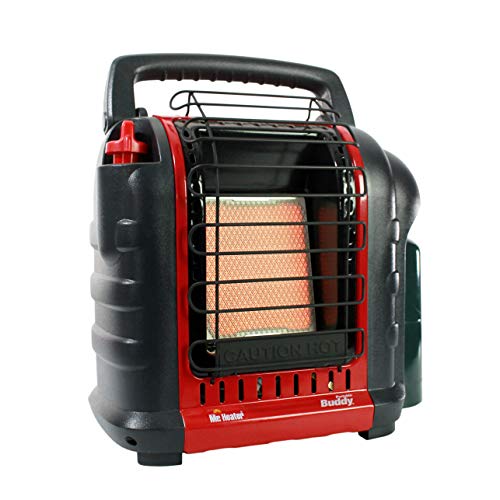
1. Mr. Heater Buddy Indoor Safe Portable Propane Heater
Mr. Heater is the industry leader when it comes to safe indoor propane heaters and for good reason.
They build quality heaters that work and have tons of safety features.
I’ve used this exact heater in my own trailer on many cold days and it works great.
The Buddy heater can output 4,000-9,000 BTU and is made for indoor and outdoor use.
It’s built to be used with a 1 lb propane tank but if you get this hose (click to view on Amazon) you can connect it to a 20 lbs or even 30 lbs propane tank that is regulated for low pressure appliances.
Note that Mr. Heater prohibits the use of using accessories or attachments on their heaters that aren’t from their own company.
Luckily, the hose I linked to is a Mr. Heater product and is approved for the Buddy heater.
It’s also long enough you should be able to store the propane tank outside of the RV to stay compliant with regulations.
Because you can use a small 1 lb tank or a larger propane tank this heater is very versatile.
You can use it inside your RV or tent for regular heating or connect a smaller tank and take it outside with you.
Like most Mr. Heater propane heaters the Buddy heater has an auto shut-off that activates when the LP heater gets knocked over.
I suggest trying it out when you first get it so you can understand how it works.
There is also a low oxygen detector and a pilot light sensor that will shut off the heater as well.
See Also: Best Portable Electric Heated Blankets For Camping
Another thing about this small propane heater is it can run properly at high elevations up to 7,000ft.
A lot of other LP gas heaters won’t work well at this altitude.
If you are higher than 7,000ft, you may have trouble lighting the Buddy heater. It might not even turn on due to the low oxygen sensor.
So, how long does a Buddy heater run on a small propane tank?
A 1 lb tank of propane holds about a quarter of a gallon of propane.
That means there are around 22,000 BTU of fuel you can burn up. If you run the Buddy on high (9,000 BTU) you will get around 2.5 hours of use.
That being said, when inside a tent, van, or RV, the Buddy can heat up an area fairly quickly and you may find that the low setting can even be too much heat after a while.
The Buddy heater has a fold-down handle, weighs only 9 lbs (without the propane tank attached), and is 15 inches tall, 13.4 inches wide, and 7.7 inches thick.
When using inside or even outside make sure you follow the instructions and learn how much open space around it is required to use this small propane heater safely.
This is one of the few portable propane heaters that can be mounted to a wall. Which is a fantastic feature for RV use.
Hanging it on the wall will get it out of the way so there’s no risk of it being knocked over by accident.
When lighting this indoor propane heater, follow the instructions on the turn knob located on the top left-hand side.
You basically hold the knob down to get the pilot light started, wait for 30 seconds, then turn the knob to light the burner.
You can then control the heat intensity with the knob.
The Mr. Heater Buddy Indoor Safe Portable Propane Heater is a fantastic choice for campers.
It works great in an RV, van, tent, pop-up camper, camping shelter, hunting blind, or garage.
Remember to have some sort of ventilation (open a window) and always make sure the propane heater has a safe amount of empty space around it.
PROS
- Automatic Tip-Over, Low Oxygen, & Pilot Light Shut-Off
- Portable
- Compatible With Larger Propane Tanks With Hose Adapter Accessory
- Can Run From 4,000-9,000 BTU
- Easy To Light
- Can Run Regularly Up To 7,000ft Elevation
- Good For Indoor & Outdoor Use
- Ventless
- Uses No Electricity
CONS
- Low Setting Still Very Hot
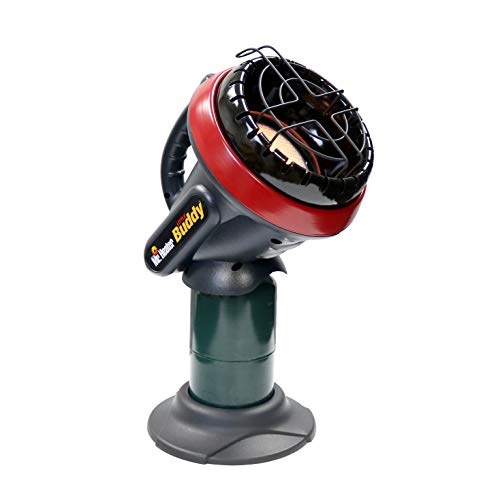
2. Mr. Heater Little Buddy Small Indoor Safe Propane Heater
The Mr. Heater Little Buddy is a smaller version of the Buddy heater reviewed above.
It’s a fantastic tool for heating tents, vans, small trailers, or just keeping a room in your home or area in your RV extra toasty.
It’s a tank top propane heater, and although most other LP heaters of this kind are not indoor safe, the Little Buddy heater is.
It’s a small portable heater made to heat rooms up to 95 square feet or to keep you warm outdoors.
It has a heater head that points up at a 45-degree angle and there is a built-in plastic handle behind it you can use to carry the heater around.
The pilot light is lit using a large button on the side and there is only one heat setting that burns at 3,800 BTU.
The Little Buddy propane heater can only be used with a 1 lb propane tank which means it will run for around 6 hours in total.
If you use this LP heater with 1 lb propane tanks often, it can be annoying having to buy a new tank every time and trying to figure out how to recycle or dispose of the old one.
I suggest getting a refillable 1 lb propane tank with a refill kit like the Flame King Refill Kit (click to view on Amazon).
Using this kit you can use a larger propane tank to refill the reusable 1 lb one.
That means you don’t need a huge supply of 1 lb propane tanks to stay warm on long camping trips and it’s way more affordable.
See Also: How Long Will An RV Battery Run The Furnace? + Calculations
Like other Mr. Heater propane heaters, the Little Buddy heater has an auto shut-off that activates when tipped over, if it senses low oxygen levels, or the pilot light goes out.
It can work at elevations up to 7,000 feet.
If you are using this inside make sure there is always a propane detector nearby just in case.
Because it’s ventless, this propane heater does require ventilation of at least 4 square inches for safe indoor use.
The Little Buddy heater is for outdoor and indoor use.
When using indoors make sure there is at least 2 feet of space in front of the propane heater, 30 inches above it, and 6 inches on each side.
There doesn’t need to be any space behind it which means you can place this LP gas heater against a wall.
The Mr. Heater Little Buddy Small Indoor Safe Propane Heater is a fantastic small portable propane heater you can use inside your home, RV, van, tent, hunting blind, garage, or outdoors.
It may be small but it still puts out a lot of heat and has all the safety features of the larger Buddy propane heaters.
It’s the perfect more economical way to keep the area you are in extra toasty instead of heating the entire RV.
PROS
- Automatic Tip-Over, Low Oxygen, & Pilot Light Shut-Off
- Portable
- Easy To Light
- Can Run Regularly Up To 7,000ft Elevation
- Good For Indoor & Outdoor Use
- Runs For Up To 6 Hours
- Great For Small Spaces Like Tents Or Bathrooms
- Ventless
- Uses No Electricity
CONS
- Only Compatible With 1lb Propane Tanks
- Only One Heat Setting
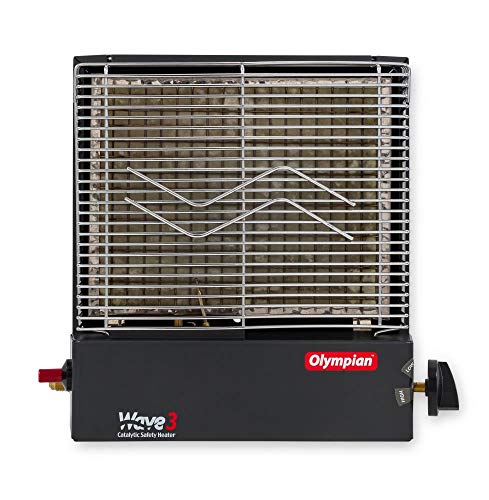
3. Camco Olympian Wave 3 LP Gas Catalytic Heater
Camco’s RV catalytic propane heaters come in a few sizes ranging from 3,000-8,000 BTU.
Because this article focuses on small portable heaters that don’t have to be wall-mounted I will be reviewing the Camco Olympian Wave 3 which is the 3,000 BTU RV propane heater.
The Wave 3 can stand on its own with the provided legs or be installed into the wall of an RV.
Camco recommends having a professional do the installation for safety and legal code reasons.
When used as a portable propane heater the Olympian stands around 18 inches tall, 12 inches wide, and 5 inches thick, these measurements include the legs.
The Camco Wave heaters for RV use are catalytic propane heaters.
They don’t technically use an open flame to heat but instead a combustion process between the propane, oxygen, and a catalyst.
This is a safer and more efficient way of heating. Warmth from the heater is felt immediately as it warms up the objects surrounding it using radiant infrared heat.
The Wave 3 is adjustable and can use 1,600-3,000 BTU of energy.
On the lowest setting, it could heat for 57 hours on just one gallon of propane which is about 4.2 lbs.
Because there is no open flame involved, catalytic propane heaters are much safer for RV use.
They don’t need all the extra safety features like the tip-over shut off.
They do use oxygen though, so make sure you use it in a well-ventilated area like you would with a regular propane heater.
It has a safety shut-off for accidental non-ignition fuel discharge.
One upside to no low-oxygen sensor is this heater can be used at higher altitudes than the Mr. Heater propane heaters.
See Also: Best Portable Power Station/Solar Generator For Camping
Unfortunately, this propane heater needs a few extra parts if you are planning on connecting it directly to a propane tank.
If your RV has a quick connect you can attach that directly to the heater but if you are using an external tank you will need a hose with a propane regulator on it.
Camco makes it easy and they sell the two parts you will need which are the Camco Elbow Connector (click to view on Amazon) and the Camco Low-Pressure Gas Regulator w/ 12 Foot Hose (click to view on Amazon).
Using these parts you can connect the Olympian Wave Heaters to any size of an external propane tank.
The Camco Olympian Wave 3 LP Gas Catalytic Heater is the most efficient RV propane heater in this review.
You can either use it as a free-standing space heater or wall mount it to be used as your main heating source.
It’s very safe and great for use in small spaces like vans and can even be used outdoors.
PROS
- Automatic Pilot Light Shut-Off
- Easy To Light
- Can Run In High Altitudes
- Extremely Efficient
- Has Extra Low Setting For Heating Small Spaces
- Can Be Wall Mounted
- Multiple Size Options
- Ventless
- Uses No Electricity
CONS
- Needs Extra Parts To Connect To Outside Propane Tank
4. Neiko Camping Butane/LP Gas Heater
The Neiko Camping butane or LP gas heater is slightly different than the other small portable indoor propane heaters on this list.
The first main difference is it can run on butane using the small disposable canisters you can buy online (click to view on Amazon) or at hardware stores.
This is a better option for some van or tent campers because a lot of people use these portable stoves (click to view on Amazon) that also use the butane canisters.
If you use a butane can this heater can run for up to 5.5 hours on the lowest setting.
The good news is the portable heater can also be used with propane you just need to get a propane hose with a regulator like this one (click to view on Amazon) that is compatible with the included LP gas adaptor.
Note: you may need to buy the heater before the regulated hose to get the right kind of adapter as it is an uncommon adapter included with the heater.
Now to the specifications. The Neiko can heat up to 4,400 BTUs which is quite a bit of heating power for this size of a propane heater.
It’s adjustable which means you use fewer BTUs on the lowest setting, but it isn’t listed how low the heater can be adjusted to in BTUs.
See Also: Best Portable Solar Panel Charger For RV Camper/Boondocking
If you run it at the highest setting you can get around 5 hours of heat per 1 lb of propane.
This is a very basic camping heater that doesn’t have all the bells and whistles of the other propane heaters in this review.
That means no safety features. If you are going to use this heater in your RV, tent, van, or home you need to be extra careful with it.
It must be monitored at all times in case it gets tipped over and you need to have plenty of ventilation when using it.
It’s small weighing only 5.5 lbs and is 12 inches tall, 12 inches wide, and 9.5 inches from front to back.
It’s very portable and easy to pack up and store for emergencies.
The heater part even tilts so you can direct the heat more upwards if it’s placed on the floor. There is a carry handle on top as well.
The Neiko Camping Butane/LP Gas Heater is not technically as safe as other kinds of indoor propane heaters.
But I wanted to include it in my review because of its ability to run on butane cans and its great portability and heating features.
It’s more old school than Mr. Heater and Camco propane heaters, but it still works so long as you give it plenty of space, only use it when you are nearby, and have good ventilation.
PROS
- Easy To Light
- Can Run In High Altitudes
- Adjustable Heat Settings
- Small & Portable
- Tiltable Head
- Can Run On Butane Or Propane
- Can Be Used Indoors Or Outdoors
- Ventless
- Uses No Electricity
CONS
- No Auto Shut-Off Features
- Needs Extra Parts To Connect To Outside Propane Tank
- Needs Extra Air Flow To Heat Properly
- Needs More Open Space For Safety
- Not As Safe As Other Propane Heaters In Review
5. Gasland Propane Radiant Heater
The Gasland is a cabinet style propane radiant heater that can be used indoors and in RVs.
It’s also great for outdoor use and large spaces like garages and workshops.
It can put off 6,000, 12,000, and 18,000 BTUs of heat using the 3 heat settings. Each setting lights different numbers of radiant heat panels.
Each panel puts off 6,000 BTUs which is why only one panel will be lit on the lowest setting.
The different heat settings make this a fantastic choice for small spaces like RVs and campers but also great for home and garage use.
The low setting will warm up to 150 sq. ft and the high up to 450 sq. ft.
The top of the cabinet is where the Piezo ignition button is located as well as the temperature dial.
It’s a little larger than some of the other RV propane heaters in this review but still very portable because it has wheels.
It’s compatible with 20 lbs propane tanks only.
There is a shelf for the tank in the back of the radiant propane heater which means you can wheel everything around and transport it easily.
See Also: Best Remote Start Generators – Portable & Inverter
There is a built in propane regulator and hose which means you can just hook up the 20 lbs propane tank and start heating.
This cabinet style RV propane heater has all the built-in safety features you want for an indoor LP heater.
It has a low oxygen cut off, a tip over shut off, and a wire guard on the front to protect the ceramic heating panels.
One downside is because of the low oxygen shut off this small propane heater is not recommended for elevations over 4,500 feet.
It measures 21.7 inches tall, 15 inches wide, and 17.5 inches wide (including the tank). The weight is 17.4 lbs without the tank attached.
The Gasland Propane Radiant Heater is perfect for all of your heating needs whether it’s inside or outside.
It’s super portable since it has wheels and the LP tank attaches directly to it.
It also has all the standard safety features and puts out radiant heat which is extremely efficient and great for heating up even large areas quickly.
PROS
- Holds Propane Tank In The Back
- Sits On Wheels (Portable)
- 3 Heat Settings
- Ignition Button (Easy To Light)
- Tip-Over & Low Oxygen Shut Off
- For Indoor & Outdoor Use
- Ventless
- Uses No Electricity
CONS
- Not Good For High Altitudes
- Not Suitable For Really Small Spaces (Vans & Cars)
- No Tip-Over Shut Off
6. Mr. Heater Vent-Free Radiant Propane Heater
My final small portable propane heater for indoor and RV use is of course, another Mr. Heater product.
What can I say? Mr. Heater makes a lot of great LP gas heaters that are perfect for homes, RVs, camper, vans, and in some cases, tents.
The Mr. Heater vent free radiant propane heater is one that is slightly less portable because of its size, but it still stands on its own and can be moved if necessary.
It’s not the best propane heater for small spaces like in vans or tents, but it’s perfect for campers, RVs, garages, and homes.
The radiant LP gas heater stands at 22.5 inches tall, is 19.75 inches wide, and 11.25 inches from front to back.
It can be wall-mounted if you prefer to make it a more permanent part of your RV, home, or garage.
This is the smallest version of the Mr. Heater radiant heaters. It has two burners that can output up to 10,000 BTUs.
It isn’t specified how many BTUs the low setting outputs, but if it’s anything like other radiant propane heaters each panel probably outputs 5,000 BTUs.
The low setting should be around 5,000 BTUs.
See Also: How Cold Can It Get Before I Need To Winterize My RV?
Running on high at the max 10,000 BTUs it will take around 9 hours to burn 1 gallon of propane. 2.2 hours for a pound of propane.
There is an automatic low oxygen sensor shut off on the unit.
It’s a great safety feature for indoor use, but it makes it so this small propane heater can only be used in elevations up to 4,500 feet.
Unlike other Mr. Heater propane heaters, this does not have a tip-over shut off which means you need to be careful around it.
You can bolt the feet to the floor or wall mount it if you want to be extra careful.
Unlike the common blue flame propane heaters, radiant heaters use infrared heat to warm the objects around them instead of the air.
It helps with efficiency because the heater can make you warm without having to heat empty space.
The Mr. Heater Vent-Free Radiant Propane Heater is the perfect option for using inside RVs and large trailers.
It’s even great for home and garage use. It warms quickly and efficiently which is one of the huge benefits of radiant propane heaters.
PROS
- Low Oxygen Sensor
- Easy To Light
- Extremely Efficient
- Can Be Wall Mounted
- Multiple Size Options
- Ventless
- Uses No Electricity
CONS
- Not Good For Outdoor, Van, Or Tent Use
- No Tip-Over Shut-Off
- Needs Extra Parts To Connect To Outside Propane Tank
- Needs Extra Air Flow To Heat Properly
What To Look For In A Small Propane Heater For RVs & Indoors
Propane Tank Size
A big thing to look for in a small propane heater for your RV, van, camper, or tent is what kinds of propane tanks are they compatible with.
According to America’s NFPA (National Fire Protection Association) regulations, it’s not allowed to bring any propane tanks larger than 1 lb indoors.
Many people still do it, but it’s not recommended.
You could potentially get in trouble for it if there is a fire and they find out you had a large propane tank inside.
There are a few ways you can work around this for RV and even home use.
The first way is to just use a 1 lb propane tank.
Many of the small propane heaters on this list are compatible with 1 lb propane tanks and it makes them even more portable.
You can even get refillable 1 lb propane tanks you can fill up yourself with this Flame King Refill Kit (click to view on Amazon).
It’s safe and follows regulations for using propane tanks indoors.
Another thing you can do is get an extra long propane hose (click to view on Amazon) and run it from outside your RV or home to inside.
You could also have a professional run a permanent LP gas line inside your home or RV.
That gives you the choice of using a small portable propane heater or even a ventless wall mount one.
Once you decide on what size of propane tank you want to use and how you are going to get the propane into your camper or home, make sure the propane heater you get is compatible with your set up.
Maximum & Minimum BTUs
Propane heaters put out a lot more heat than electric ones.
You may not need a great big one to heat your entire RV, garage, or rooms in your home.
Even the tiny and very portable Mr. Heater Little Buddy puts out some serious heat and could make a small space too warm.
I’ve used the Mr. Heater Buddy propane heater like the one at the top of this review in my own 32 foot travel trailer.
Once the trailer heats up, even the lowest setting keeps the trailer warm.
See Also: 6 Fun RV Comforters & Bedspreads For The Camper Or Home
Sometimes in chilly but not freezing weather a more mellow heater like the Camco Olympian RV Wave-3 would be a better option, even in a big RV like mine.
The BTU output also affects the amount of propane used.
If you have access to a large tank then getting a high BTU propane heater might work for you.
If you boondock/dry camp a lot and only have two #20 or #30 propane tanks a propane heater that is more efficient and has a lower BTU output might be a better option.
Safety Features
There are all sorts of safety features on propane heaters, especially the small portable ones that aren’t secured to anything.
Many of the ones in this review have low oxygen sensors.
These are very common for ventless propane heaters.
If there isn’t enough ventilation, oxygen levels will get low as the burner uses it up and replaces it with carbon dioxide.
This sounds scary but indoor propane heaters are safe so long as there is enough ventilation in the area.
All you need to do is make sure you leave a window cracked or a door open to allow airflow.
Better airflow also helps propane heaters heat more efficiently.
Low oxygen sensors are so sensitive and good at what they do they often stop propane heaters from working at high elevations.
If you live over 5,000 feet you may want to consider getting a propane heater without a low oxygen sensor.
Otherwise, it might instantly activate and stop you from lighting the burner.
The tip-over shut off is another great safety feature you will find on some of the smaller propane heaters in this review.
It’s not a must have, but it does give peace of mind. Especially if you have pets or kids.
Most of the best propane heaters will have a safety shut off that will stop propane from flowing if the burner doesn’t ignite or the pilot goes out.
See Also: 6 Best Camping Wool Blanket Reviews For Tent, RV & Van

Conclusion & My Recommendations For Small Portable Indoor RV Propane Heaters
Even in the mellowest of climates, chilly mornings are going to follow you everywhere.
It’s especially hard when you are camping in an RV, van, or tent because normally it’s the same temperature inside as it is outside when you first wake up.
Small portable indoor propane heaters are a fantastic way to warm up in the morning without having to use any electricity.
Portable propane heaters are always ventless.
Most are compatible with 1 lb propane tanks, which means you don’t need to do any kind of installation if you don’t want to.
See Also: Best Heated Water Hoses For RV Campers, Barns & Livestock
Deciding on the one that’s best for you is easy once you know what you want to use it for, and the size of the area you want to use it in.
If you camp in a van, tent, or small camper you are going to want a small portable propane heater like the Mr. Heater Little Buddy.
If you want a heater that works well indoors and outdoors a slightly larger but still portable heater like the Mr. Heater Buddy is a great option.
If you want an extremely efficient propane heater for inside the RV that has the option to wall mount some of the larger options will be best.
Now that you know some of the best options for RV propane heaters out there here are some of my recommendations for certain uses.
Best Overall – Mr. Heater Buddy Indoor Safe Portable Propane Heater
Mr. Heater knows what it’s doing when it comes to the safest and best propane heaters for indoor, camping, and RV use.
They make many different styles of heaters but their Buddy version is the best overall.
I like that it can easily connect to all kinds of propane tanks from 1lb to larger ones.
It’s a good size for small or large indoor spaces or staying warm when spending time outdoors.
It’s portable, easy to pack away, and can be used in tents.
The safety features are unmatched by any other portable indoor propane heater.
It even has the auto shut-off for accidental tip-overs which is one of the most important features for a small propane heater that is easy to miss and could be knocked over.
I’ve used this heater on cold mornings in my own 32-foot travel trailer and it’s done very well heating everything.
Once my trailer gets warm I sometimes have to turn it off because it puts out so much heat even at the lowest setting.
Most Portable – Mr. Heater Little Buddy Small Indoor Safe Propane Heater
While the Mr. Heater Buddy is also very portable when using a 1 lb propane tank, the Mr. Heater Little Buddy is always going to be super portable and very easy to carry around.
It has a large handle on top you can use to carry it, and it’s extremely lightweight and easy to store.
It’s a fantastic choice for adding a little more heat to your personal space or using it as the main heater in a van or tent.
It has all the safety features of the Buddy like the tip-over shut off, and low oxygen sensor.
It burns at a fairly high BTU for its size which means it will be able to keep larger areas than you think toasty and warm.
The only downside is there’s only one heat setting.
I’ve used this version in my travel trailer and motorhome.
It was perfect for mild temperatures in the large travel trailer, and plenty of heat for colder mornings in my small motorhome.
Most Efficient – Camco Olympian Wave 3 LP Gas Catalytic Heater
Catalytic heaters unlike regular blue flame or radiant propane heaters don’t use flames to heat.
Instead, they use combustion between a catalyst, propane, and oxygen to create heat.
There is a flame used to start the combustion process but once the process has been started the pilot goes out there there is no longer an open flame.
This makes the Camco Olympian Wave 3 catalytic heater very safe and perfect for use in small spaces like RVs, vans, and even some tents.
They are also extremely efficient and put out a lot of heat with just a little bit of fuel.
Even though it only uses 1,600 to 3,000 BTU it can still heat spaces up to 130 square feet.
It can also be nicer for small spaces since the low setting is milder and you will be able to leave it one without getting uncomfortably hot.

Frequently Asked Questions About Portable Propane Heaters
How many BTUs is a gallon of propane?
One gallon of propane is 91,502 BTUs of energy.
How many pounds is a gallon of propane?
One gallon of propane weighs 4.2 lbs.
How many BTUs are in a 1 lb propane tank?
There are about 21,000 BTUs in a 1 lb propane tank.
Is it safe to leave a portable propane heater on at night?
Portable propane heaters are generally safe but like any small space heater, they have their risks.
I don’t recommend leaving one on at night but the end decision is up to you and how safely positioned the propane heater is.
If you have pets or children you should never leave the heater running at night or unattended.
If you plan on using a portable propane heater for overnight heating, use it plenty during the day first.
That way you’ll know if it has any problems and that the heater runs well in the space you have chosen.
Also, always have a tested carbon monoxide detector nearby.
Are portable propane heaters ok to use indoors?
A portable propane heater is only safe to use indoors if it is made for indoor use.
You should always have some sort of ventilation whenever using any propane appliance inside.
Heaters that go on the top of the propane tank (tank top heaters) are generally never safe to use indoors unless specifically made for indoor use like the Mr. Heater Little Buddy reviewed above.
Be sure to follow all of the safety instructions for your specific portable propane heater and always have a propane detector nearby at all times.
What is the smallest propane heater?
The Little Buddy by Mr. Heater (click to view on Amazon) is one of the smallest portable propane heaters on the market today.
You can read more information about it in the reviews section at the beginning of this article or check out the full review here (click to view).
Do you need ventilation when using an indoor ventless propane heater?
Yes, you always need to have ventilation when using any indoor propane product especially if it’s ventless like portable propane heaters.
Because they burn oxygen and have some emissions, they introduce a carbon monoxide risk if not properly vented.
That is why you should always have a propane detector nearby at all times.
When using a ventless propane heater in an RV, van, or tent you can usually achieve proper ventilation by partially opening a window.
Because RVs have a lot of propane appliances it’s recommended to always have at least one window cracked to allow some ventilation at all times.
Also, always make sure your carbon monoxide sensor is in working condition.
Can a portable propane heater be used in a tent, hunting blind, or camping shelter?
Yes, if the propane heater is rated for indoor use, has enough open space to run safely, and is used carefully it can be used inside a tent, hunting blind, or camping shelter.
Just make sure you always leave a window open enough for proper ventilation and use a propane detector alarm.
What does the low oxygen sensor on a portable propane heater do?
Propane heaters burn oxygen.
If you use one in a closed space that doesn’t have any ventilation or airflow, your heater will eventually eat up all the oxygen in the air.
No oxygen in the air is not good for humans, and it’s hard for your body to tell when oxygen levels in the air are getting low.
The low oxygen sensors on propane heaters test the air and will shut off the burner and gas if the levels start to get too low.
It’s a neat safety feature and a good one to have, especially for indoor or RV propane heaters.
That being said you should never 100% trust any of the safety features. Nothing is perfect and sometimes these features fail.
Always make sure there is plenty of airflow and ventilation in any space you are using a propane appliance.
This ensures the oxygen levels will stay safe.
What is more efficient an electric space heater or small propane heater in an RV?
It really depends on how much your electricity costs and how much propane is.
If you’re boondocking and don’t have access to very much electricity, you are going to want to use a portable propane heater because they don’t use any electricity.
They also use way less propane than the built-in RV furnace.
The most efficient way to go is a catalytic propane heater like the Camco Olympian Wave 3 LP Gas Catalytic Heater.
Catalytic heaters put out a lot of warm radiant heat and they use hardly any propane.
Price-wise they may even be more economical than an electric space heater in the long run.
A standard blue flame or radiant propane heater might not be as efficient as an electric space heater.
They put out more heat and are better for large spaces.
If you are comparing a small space heater with a small propane heater the price difference for energy isn’t that much.
How much propane does a portable propane heater use?
It depends a lot on the size and style.
A catalytic propane heater uses hardly any propane while a regular blue flame or radiant propane heater that has a flame can use quite a bit.
If you look at the table at the beginning of this review, it will tell you the max run time on 1 lb of propane for each of the 6 best portable indoor propane heaters in this review.
How to duct or vent a portable propane heater
Portable propane heaters rated for indoor use are ventless and do not need ducting, that’s what makes them portable.
That being said you should always have some ventilation in the area you are using the heater.
Normally cracking a window or door creates enough ventilation for a small propane heater.
How long does a Buddy heater run on a small propane tank?
The Mr. Heater Buddy will run for around 5.5 hours at the lowest setting and 2.4 hours at the highest setting when connected to a small 1 lb propane tank.
The Mr. Heater Little Buddy only has one heat setting and will run for around 6 hours on a small 1 lb propane tank.
Have any more questions about portable propane heaters for indoor or RV use? Leave a comment below.

